If you have searched for an AI test engineer roadmap, you have probably found two useless extremes — articles telling you to go learn calculus and neural networks, or vendor blogs telling you to buy an autonomous testing platform and forget everything you know. Both are wrong for a working QA engineer.
This AI test engineer roadmap is different. It is written by a QA engineer for QA engineers, and it treats AI testing as an evolution of your existing automation skills — not a restart from zero. You already have most of the foundation. This roadmap bridges it into AI testing in four phases over six months.
What is the AI test engineer roadmap?
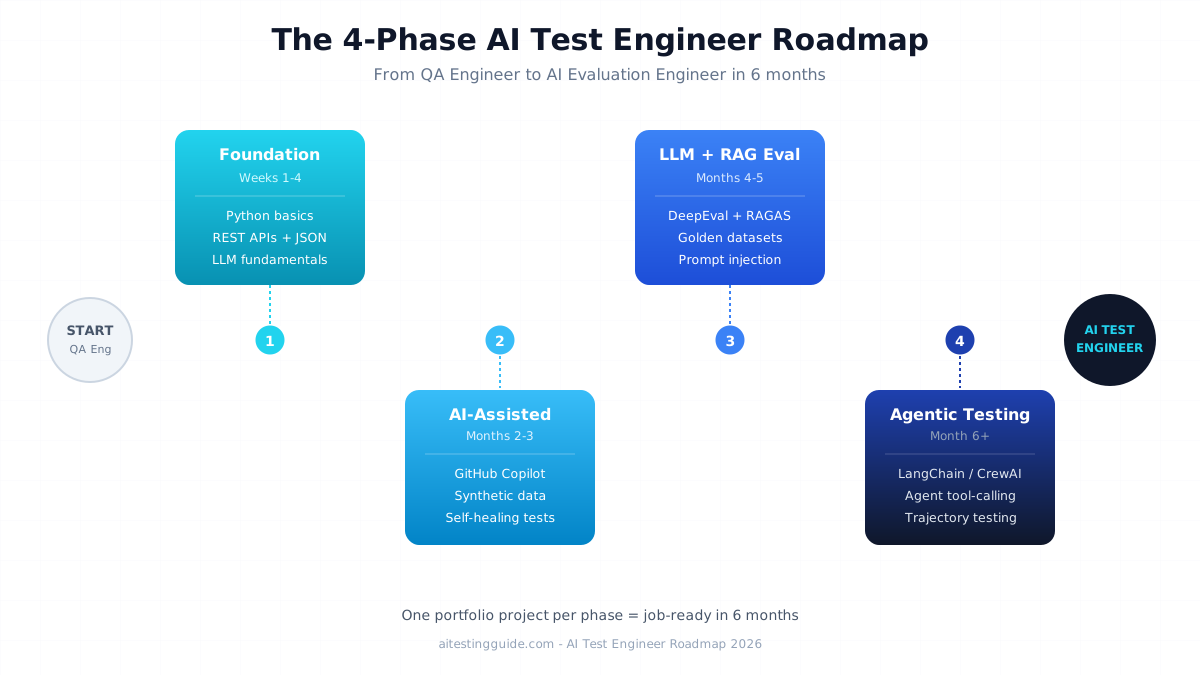
The AI test engineer roadmap is a 4-phase, 6-month path that transitions a QA or automation engineer into AI testing. Phase 1 builds Python and API foundations. Phase 2 adds AI-assisted automation with GitHub Copilot and Playwright. Phase 3 covers LLM and RAG evaluation with DeepEval and RAGAS. Phase 4 reaches agentic testing. You do not need calculus or machine learning theory — you need APIs, JSON, Python, and your existing test automation skills.
Table of Contents
Using AI to Test vs Testing AI Systems
The AI test engineer roadmap splits into two distinct tracks, and confusing them is the biggest mistake beginners make. Understanding the difference is the first step on the roadmap.
- Using AI to test — leveraging tools like GitHub Copilot and self-healing frameworks to write test scripts faster, generate test data, and fix flaky selectors. This makes you a faster automation engineer
- Testing AI systems — validating LLMs, RAG applications, and AI agents for accuracy, hallucinations, and security. This makes you an AI evaluation engineer
The high-paying roles in 2026 are in the second track — testing AI systems. Recruiters are hiring AI evaluation engineers, and that is where this roadmap takes you. For the broader career context, see our guide on whether AI will replace QA engineers.
Do You Need to Learn Calculus or Machine Learning?
No — you do not need calculus, linear algebra, or neural network theory to become an AI test engineer. This is the myth that scares QA engineers away, and it is wrong. You are testing AI systems, not building them.
What you actually need is far more achievable for someone with a QA background:
- Python or Java — you likely already have this from automation work
- APIs and JSON schemas — core to calling and validating LLM endpoints
- Vector databases (concepts) — enough to understand how RAG retrieval works
- Evaluation metrics — faithfulness, answer relevancy, context recall
A data scientist builds the model. An AI test engineer validates that the model behaves correctly. Those are different jobs requiring different skills — and yours are closer than you think.
Phase 1 — Foundation (Weeks 1-4)
Phase 1 of the AI test engineer roadmap builds the coding and API foundation. If you already write automation in Python or Java, you can move through this phase quickly.
- Solidify Python basics — data structures, functions, working with JSON
- Learn to call REST APIs and parse responses (you likely know this from API testing)
- Understand LLM fundamentals — tokens, context windows, temperature, system prompts
- Make your first OpenAI or Anthropic API call and inspect the JSON response
By the end of Phase 1, you can call an LLM programmatically and understand what comes back. That is the entire foundation. To strengthen the Python side, this Selenium WebDriver with Python course on Udemy covers the language fundamentals automation engineers need.
Phase 2 — AI-Assisted Automation (Months 2-3)
Phase 2 of the AI test engineer roadmap integrates AI coding assistants into your existing automation. This is the bridge phase — you use AI to become a faster automation engineer before you start testing AI itself.
- Use GitHub Copilot to generate Page Object classes and test scaffolding
- Generate synthetic test data and TestNG DataProviders with AI
- Build self-healing test awareness — how ML-based locators work
- Practice prompt engineering for test case generation
This phase builds directly on your existing Selenium or Playwright skills. See our guides on GitHub Copilot for test automation and how to write test cases with AI for the hands-on work.
Phase 3 — LLM and RAG Evaluation (Months 4-5)
Phase 3 of the AI test engineer roadmap is where you start testing AI systems — the high-value skill. You learn to evaluate LLM outputs programmatically using metrics, not manual checking.
- Learn evaluation metrics — faithfulness, answer relevancy, context precision and recall
- Build a golden dataset of verified question-answer pairs
- Use DeepEval to write metric assertions with pass/fail thresholds
- Use RAGAS to test RAG retrieval and generation quality separately
- Add prompt injection security testing with Promptfoo
This phase is the core of the modern AI test engineer role. Work through our guides on LLM evaluation metrics, the DeepEval review, what RAGAS is, and prompt injection testing to build these skills.
Phase 4 — Agentic Testing (Month 6+)
Phase 4 of the AI test engineer roadmap reaches the frontier — testing autonomous AI agents. This is the most advanced and most future-proof skill on the roadmap.
- Understand how agents built with LangChain, LlamaIndex, and CrewAI work
- Test agent tool-calling and verify Least Privilege constraints
- Validate multi-step agent trajectories and error recovery
- Deploy AI agents that autonomously explore and test applications
Agentic testing is the cutting edge of QA in 2026. Few engineers can do it, which makes it valuable. See our agentic testing guide and how to test AI chatbots for the practical work.
Traditional QA vs AI QA — The Skill Shift
The AI test engineer roadmap is fundamentally a shift from deterministic to probabilistic testing. Here is how the skills compare side by side.
| Aspect | Traditional QA | AI Test Engineer |
|---|---|---|
| Assertions | Exact match (True/False) | Score thresholds (0.8+) |
| Output | Deterministic | Probabilistic |
| Tools | Selenium, TestNG | DeepEval, RAGAS, Promptfoo |
| Key metric | Pass/fail rate | Faithfulness, hallucination rate |
| Test data | Fixed datasets | Golden datasets + synthetic |
| Security focus | SQL injection | Prompt injection |
Notice your existing skills map directly across — you are evolving, not restarting. See our full how to become an SDET guide for the automation foundation.
The Enterprise Realities Nobody Mentions
Most AI test engineer roadmaps skip the day-to-day realities of testing AI in a real company. These three are what separate a junior from a senior AI test engineer.
- API token costs — running thousands of tests through paid LLM APIs gets expensive fast. Senior engineers manage token budgets and cache results
- Data privacy and PII — never feed real customer data into public AI models. Know how to handle GDPR and HIPAA compliance with synthetic data
- Legacy integration — most real systems are not greenfield. Know how to add AI testing to older monolithic architectures
Mentioning these in an interview instantly signals you understand the real job, not just the tutorial version. This is the practical edge a working QA engineer has over a bootcamp graduate.
AI Test Engineer Salary and Job Outlook
AI test engineers command higher salaries than traditional QA because the skill set is rare and in high demand. The evaluation and agentic testing skills from Phases 3 and 4 are what drive the premium.
Salaries vary by region and experience, but AI test engineering roles consistently pay above standard automation roles because so few engineers can validate LLM systems. The fastest way to command the premium is a portfolio that proves you can evaluate AI — a RAG evaluation suite, a prompt injection test report, an agentic testing project. For detailed salary data across testing roles, see our SDET salary guide.
Real-World Use Case — A QA Engineer’s 6-Month Transition
Here is how a manual-leaning QA engineer used this AI test engineer roadmap to land an AI evaluation role in six months.
Starting point: Two years of manual QA with basic Selenium knowledge. No AI experience.
- Months 1: Python refresher, first OpenAI API calls, understood tokens and context windows
- Months 2-3: Used Copilot to rebuild an existing Selenium suite faster, generated synthetic data
- Months 4-5: Built a RAG evaluation suite with DeepEval and RAGAS on a sample chatbot, published it on GitHub
- Month 6: Added a Promptfoo red teaming report, applied to AI evaluation roles with the portfolio
The result: The GitHub portfolio with a real RAG evaluation suite was the difference-maker. It proved hands-on ability that interviews alone never could. The roadmap works because each phase produces a portfolio artifact, not just knowledge.
Final Thoughts
The AI test engineer roadmap is not a restart — it is an evolution of skills you already have. You do not need calculus. You need to bridge your existing automation knowledge into AI-assisted testing, then into LLM evaluation, then into agentic testing. Four phases, six months, one portfolio artifact per phase.
Start Phase 1 this week — make your first LLM API call and inspect the JSON. That single step puts you ahead of every QA engineer still waiting to “learn AI” someday. The role is new, the demand is real, and your QA background is the perfect starting point. Build one portfolio project per phase and you will be job-ready in six months.
Disclosure: This article contains affiliate links. If you purchase through these links I earn a small commission at no extra cost to you.
Frequently Asked Questions
What is an AI Test Engineer roadmap in 2026?
An AI test engineer roadmap is a structured path that transitions a QA or automation engineer into AI testing. The 2026 version is a 4-phase, 6-month plan: foundation (Python and APIs), AI-assisted automation (Copilot with Playwright), LLM and RAG evaluation (DeepEval and RAGAS), and agentic testing (LangChain and CrewAI agents). It builds on existing automation skills rather than starting from scratch.
How do I become an AI Test Engineer as a QA beginner?
To become an AI test engineer as a QA beginner, start with Python and API basics, then learn to call and validate LLM endpoints. Next, use AI coding assistants to speed up automation, then learn LLM evaluation metrics with DeepEval and RAGAS. Build one portfolio project per phase. The full transition takes about six months of consistent effort.
Which skills are required for AI testing engineers?
AI testing engineers need Python or Java, REST API and JSON knowledge, an understanding of LLM concepts (tokens, context windows), evaluation metrics (faithfulness, answer relevancy, context recall), and familiarity with frameworks like DeepEval, RAGAS, and Promptfoo. You do not need calculus, linear algebra, or machine learning theory — you are testing AI, not building it.
Is coding mandatory for AI Test Engineers and SDETs?
Yes, coding is mandatory for AI test engineers. Python is the undisputed standard because it integrates with every major AI testing framework and handles data manipulation cleanly. You need enough coding to call APIs, parse JSON, write metric assertions, and build evaluation scripts. Java works too, but Python dominates the AI testing ecosystem.
What tools should QA engineers learn for AI testing?
QA engineers should learn DeepEval and RAGAS for LLM and RAG evaluation, Promptfoo for prompt injection and red teaming, GitHub Copilot for AI-assisted automation, and LangChain or CrewAI for understanding the agents they will test. Foundational tools like Playwright or Selenium remain essential since AI testing builds on automation frameworks.
How is AI application testing different from traditional software testing?
AI application testing is probabilistic while traditional testing is deterministic. Traditional testing asserts exact outputs; AI testing scores outputs against thresholds like faithfulness above 0.8 because the same input produces different valid responses. AI testing also adds new concerns like hallucinations, prompt injection, and RAG retrieval accuracy that do not exist in traditional software.
What are the best AI testing projects for a QA portfolio?
The best AI testing portfolio projects are a RAG evaluation suite using DeepEval and RAGAS, a prompt injection red teaming report using Promptfoo, an AI chatbot test suite covering UI and LLM layers, and an agentic testing project validating an AI agent’s tool use. Each demonstrates a different in-demand skill and proves hands-on ability to recruiters.
How do SDETs test LLMs, chatbots, and generative AI apps?
SDETs test LLMs and generative AI apps by building golden datasets and scoring outputs with evaluation metrics rather than exact assertions. They test chatbots across two layers — UI automation for the widget and LLM evaluation for the responses. They measure faithfulness, answer relevancy, and hallucination rate, and run these checks automatically in CI/CD pipelines.
Which automation frameworks are most useful for AI testing in 2026?
The most useful frameworks for AI testing in 2026 are DeepEval and RAGAS for evaluation, Promptfoo for security testing, and Playwright or Selenium for the UI layer of AI applications. GitHub Copilot accelerates writing all of these. For agent testing, LangChain and CrewAI knowledge helps you understand what you are validating.
What is the career path and salary growth for AI Test Engineers?
The AI test engineer career path runs from QA engineer to automation engineer to AI evaluation engineer to senior AI quality roles. Salaries grow at each stage because LLM evaluation skills are rare and in high demand. AI test engineers typically earn above standard automation roles, with the premium driven by RAG evaluation and agentic testing expertise.