
If you are a QA engineer wondering how to become an SDET, you are not alone. In 2026, SDET is one of the most in-demand roles in software. Your QA background gives you a strong head start.
I made this transition myself. This guide shows exactly how to become an SDET in 2026. You will learn the required skills, tools, and a realistic timeline.
How to become an SDET in 2026: An SDET (Software Development Engineer in Test) writes code to automate testing. To become one, learn Python, master Selenium, build a Page Object Model framework, add API testing, and integrate CI/CD with GitHub Actions. With 10–15 hours per week, most QA engineers become job-ready in 9–12 months.
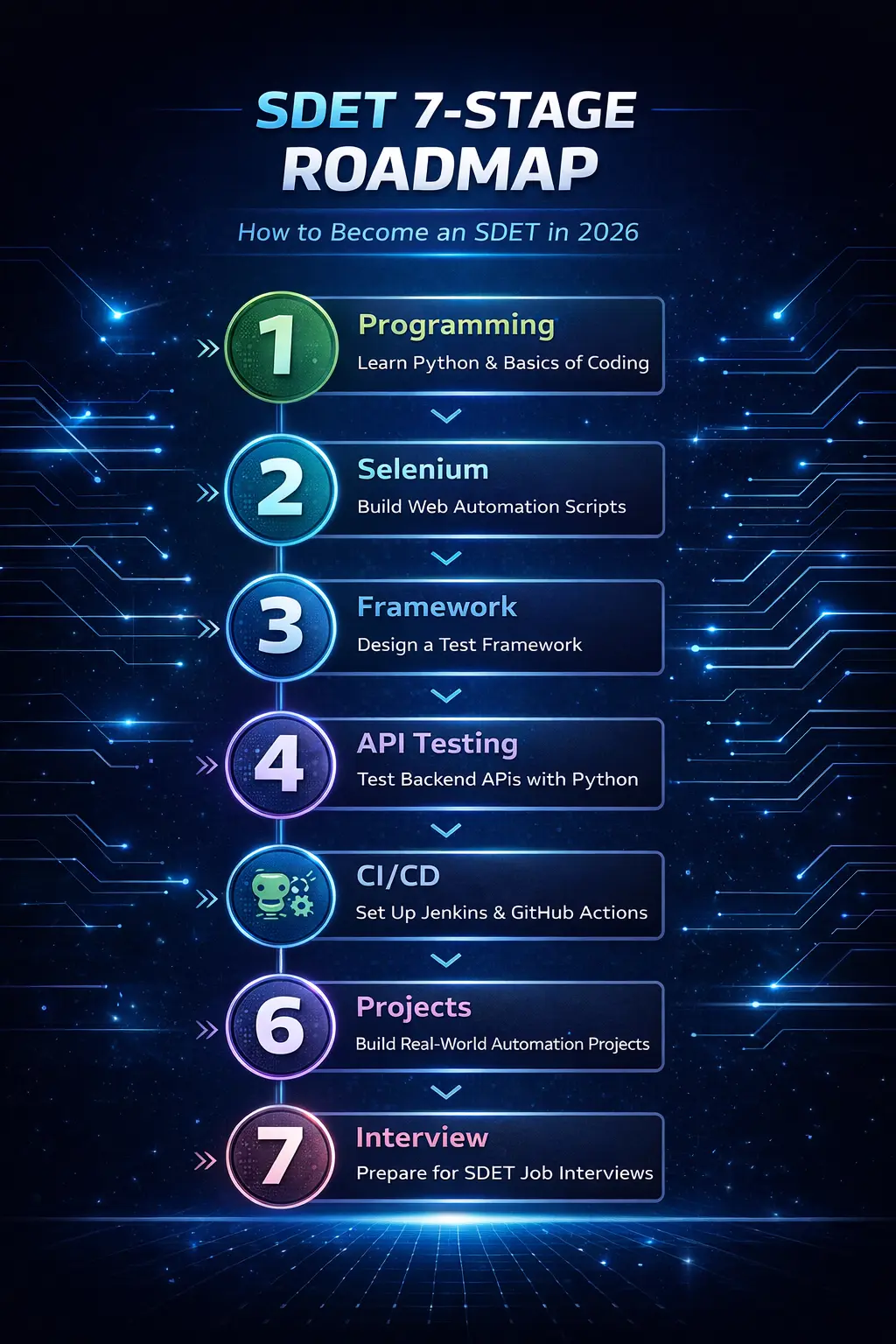
Table of Contents
What Is an SDET?
Understanding this role is the first step in learning how to become an SDET.
SDET stands for Software Development Engineer in Test. Unlike manual QA engineers, SDETs write code to automate testing. They combine development and testing skills.
SDETs build frameworks, integrate tests into CI/CD pipelines, and validate both functional and non-functional requirements. Over 70% of companies now require automation testing skills in QA roles.
Companies like Google, Microsoft, Amazon, and Meta hire SDETs at developer-level salaries. The demand for knowledge on how to become an SDET is growing as companies move toward continuous delivery pipelines.
SDET vs QA Engineer — What Is the Real Difference?
Understanding this difference is the first step in learning how to become an SDET.
| Skill | QA Engineer | SDET |
|---|---|---|
| Manual Testing | ✅ Yes | ✅ Yes |
| Test Automation | ❌ Limited | ✅ Core skill |
| Programming | ❌ Optional | ✅ Required |
| Framework Design | ❌ No | ✅ Yes |
| CI/CD Integration | ❌ Rarely | ✅ Yes |
| White-Box Testing | ❌ Rarely | ✅ Required |
| Salary Level | Junior | Mid to Senior |
The key shift is mindset. QA engineers check if features work. SDETs engineer quality into the entire development process.
How Long Does It Take to Become an SDET?
One of the most common questions about how to become an SDET is how long it takes. It takes 9–12 months to become a job-ready SDET with consistent practice.
With 10–15 hours of practice per week:
- Months 1–3 — Beginner level. Python basics and first Selenium scripts.
- Months 3–6 — Intermediate level. Build a full framework and push it to GitHub.
- Months 6–9 — Advanced level. API testing, CI/CD, and portfolio projects.
- Months 9–12 — Job-ready SDET. Interview prep and first applications.
If you have QA experience, you already start ahead of most beginners. You understand testing concepts, bug reporting, and test case design. You just need to add programming on top.
How to Become an SDET — Complete 7-Stage Roadmap
Stage 1 — Programming Foundation (Months 1–2)
Start by learning programming fundamentals using Python.
Python has become the primary entry language for 70% of new automation frameworks in 2026. It is easier to learn than Java, has massive community support, and is the default language for AI-powered testing tools like DeepEval and RAGAS.
What to learn:
- Variables, data types, loops, and functions
- Object-Oriented Programming — classes and inheritance
- File handling and exceptions
- Basic problem-solving with small programs
Free resources:
- Python.org official tutorial
- Automate the Boring Stuff with Python (free online)
Note on Java: Java remains highly valuable for enterprise SDET roles. Most SDET interview questions at large companies still use Java. Learn Python first, then add Java basics in Month 3.
Mini project: Write a Python script that reads a CSV file of test data and prints pass or fail results for each row.
Stage 2 — Test Automation with Selenium (Months 2–3)
Selenium is a core skill when learning how to become an SDET in 2026.
Selenium is used by over 80% of enterprise automation teams. Most SDET job descriptions require it. In 2026, Playwright is the modern alternative — faster, built-in async support, and better for JavaScript-heavy applications.
Learn Selenium first. Once comfortable, spend two weeks on Playwright basics. Recruiters value engineers who know both. See our Selenium vs Playwright guide for a full comparison.
What to learn:
- Setting up Selenium with Python
- Finding elements — ID, XPath, CSS selectors
- Writing your first automated browser test
- Handling waits — implicit vs explicit (common interview question)
- Run tests on Chrome and Firefox
Practice site: Use the-internet.herokuapp.com — built specifically for automation practice.
Recommended course: If you want structured Selenium learning, this highly rated Selenium Python automation course on Udemy — 4.6 stars with thousands of students — covers everything from basics to advanced framework design.
Disclosure: This article contains affiliate links. If you purchase through these links, I earn a small commission at no extra cost to you.
Tests to write:
- Login with valid credentials → verify dashboard loads
- Login with invalid credentials → verify error message appears
- Upload a file → verify confirmation message shows correctly
Stage 3 — Test Framework Design (Months 3–4)
Framework design is what separates beginners from engineers learning how to become an SDET. SDETs build reusable automation frameworks, not just scripts.
Writing individual scripts is not enough for SDET roles. You need a structured framework that any engineer on the team can use and extend.
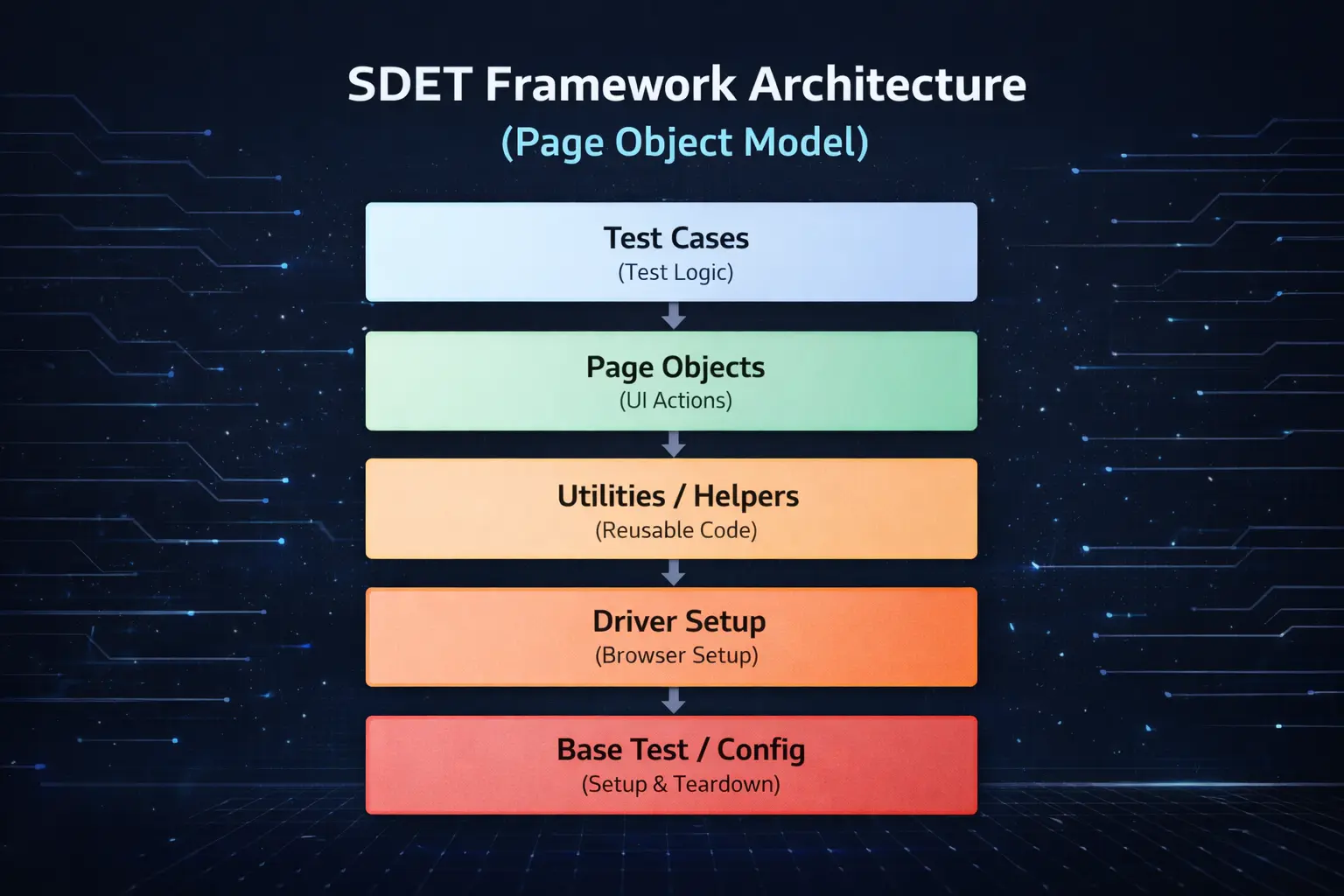
Learn the Page Object Model (POM):
POM separates page logic from test logic. Every page of the application gets its own Python class. Your test files use these page classes instead of directly interacting with the browser.
Here is how a typical SDET framework is structured using the Page Object Model:
In 2026, BDD (Behavior Driven Development) using Cucumber or pytest-bdd is increasingly required in enterprise SDET roles. Add BDD basics to your framework after mastering POM.
What to learn:
- How to create page classes for each screen
- How to use fixtures in Pytest for setup and teardown
- How to run full test suites from the command line
- How to generate HTML reports using pytest-html
See our Best Selenium Frameworks guide for the complete breakdown.
Stage 4 — API Testing (Months 4–5)
API testing is a required skill if you want to know how to become an SDET today.
Modern apps are built on microservices. Every feature you test on the UI is backed by 3–5 API calls underneath. SDETs who cannot test APIs are limited to UI automation only — a ceiling for both salary and seniority.
What to learn:
- REST API basics — GET, POST, PUT, DELETE
- Status codes — 200 success, 201 created, 400 bad request, 404 not found
- Manual API testing with Postman
- Automated API testing with Python Requests and Pytest
Free practice API: reqres.in — free fake REST API built for testing.
Tests to write:
- GET users → verify status 200 and list is not empty
- POST new user → verify status 201 and correct response body
- DELETE user → verify status 204 and deletion confirmed
Stage 5 — CI/CD Integration (Months 5–6)
CI/CD integration is a critical step in mastering how to become an SDET. CI/CD ensures your tests run automatically on every code change.
Teams using CI/CD release software are up to 30% faster. As an SDET, you plug your test suite into the pipeline — not just write tests that run locally.
When you push code to GitHub, your Pytest suite runs automatically in the cloud. Start with GitHub Actions — it is free, well-documented, and appears in almost every SDET job description in 2026.
What to learn:
- Git basics — commit, push, pull, branch
- GitHub — repositories and pull requests
- GitHub Actions — automated workflows that run your tests on every push
2026 addition — Docker basics: Learn to run your tests inside a Docker container. This ensures your tests execute identically in local, staging, and production environments. This is DevOps light — you do not need to become a DevOps engineer, but container knowledge is now a baseline SDET skill.
This skill alone makes your GitHub profile stand out. Most junior candidates do not have CI/CD set up on their projects.
Stage 6 — Build Your Portfolio (Months 6–9)
A strong portfolio is required to get interviews.
No portfolio = no interviews. Three projects are enough to become interview-ready.
Project 1 — Web Automation Framework
- Selenium + Python + Pytest + Page Object Model
- 20+ test cases on a real e-commerce demo site
- HTML reports are generated automatically
- GitHub Actions CI/CD running on every push
Project 2 — API Automation Suite
- Python Requests + Pytest
- 15+ API test cases covering all CRUD operations
- JSON response validation included
- Running through GitHub Actions
Project 3 — End-to-End Test Suite
- Combines web and API testing in one project
- Data-driven tests reading from CSV or JSON files
- Clean README with setup instructions
- Any recruiter can clone and run it in minutes
Recruiters spend less than 10 seconds reviewing a GitHub profile. Make yours impossible to ignore with working code, a clear README, and CI/CD badges showing green builds.
Stage 7 — Interview Preparation (Months 9–12)
Interview preparation focuses on automation concepts and coding basics.
Common SDET interview questions:
- What is the Page Object Model, and how do you implement it?
- What is the difference between implicit and explicit wait in Selenium?
- How do you handle dynamic elements that change on every page load?
- How do you integrate your test suite into a CI/CD pipeline?
- How do you decide what to automate versus what to test manually?
- Write a function to reverse a string
- Walk me through your automation framework design
Coding questions to prepare:
- String manipulation problems
- Basic array questions
- Simple OOP design patterns
Practice on LeetCode at the Easy level — that is sufficient for most SDET roles. See our SDET Interview Questions guide for real answers that work.
The SDET Mindset — From Checking to Engineering
The biggest shift from QA to SDET is not the tools. It is the mindset.
Manual QA engineers check if features work after they are built. SDETs influence quality before code is written — this is called shift-left testing. You review requirements, flag testability issues early, and design test cases at the architecture stage.
In 2026, senior SDETs also practice shift-right testing — monitoring quality in production using observability tools and real user data.
SDETs must also understand white-box testing. Unlike black-box testing, where you only test inputs and outputs, white-box testing requires reading the internal code, understanding logic paths, and writing tests that cover specific code branches. This is what separates an SDET from an automation tester.
Will AI Replace SDET Jobs in 2026?
No — AI is a multiplier for SDETs, not a replacement.
Remote SDET jobs have grown by over 40% since 2023. AI tools like GitHub Copilot and GenAI-powered test generators speed up script writing. But they cannot replace the engineering judgment needed to design a test strategy, debug a flaky pipeline, or test a non-deterministic AI system.
SDETs who understand AI testing are in higher demand. Testing LLM applications, validating RAG pipelines, and detecting AI hallucinations are emerging SDET skills with almost zero competition in the job market today.
The SDET who uses AI tools to move faster — while applying real engineering thinking — is the most valuable person on any QA team in 2026. See our guide to testing LLM applications for a deep dive.
Tools Every SDET Must Know in 2026
| Category | Tool | Priority |
|---|---|---|
| Language | Python or Java | ⭐⭐⭐⭐⭐ |
| Web Automation | Selenium, Playwright | ⭐⭐⭐⭐⭐ |
| API Testing | Postman, Requests | ⭐⭐⭐⭐⭐ |
| Test Framework | Pytest, TestNG | ⭐⭐⭐⭐⭐ |
| Version Control | Git, GitHub | ⭐⭐⭐⭐⭐ |
| CI/CD | GitHub Actions, Jenkins | ⭐⭐⭐⭐ |
| Containerisation | Docker | ⭐⭐⭐⭐ |
| BDD | Cucumber, pytest-bdd | ⭐⭐⭐⭐ |
| Performance Testing | k6, JMeter | ⭐⭐⭐ |
| AI Testing Tools | Mabl, Testim, DeepEval | ⭐⭐⭐ |
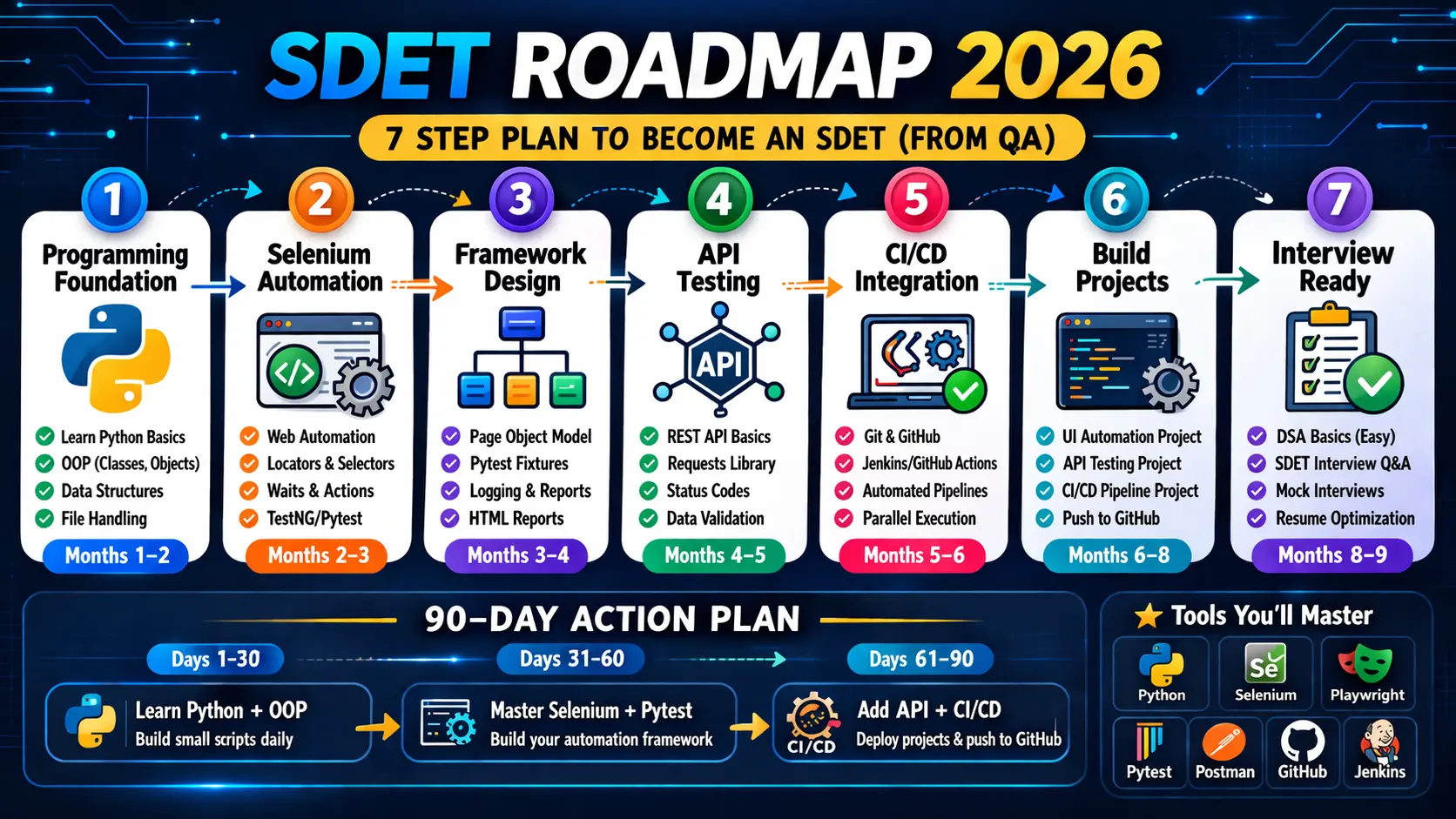
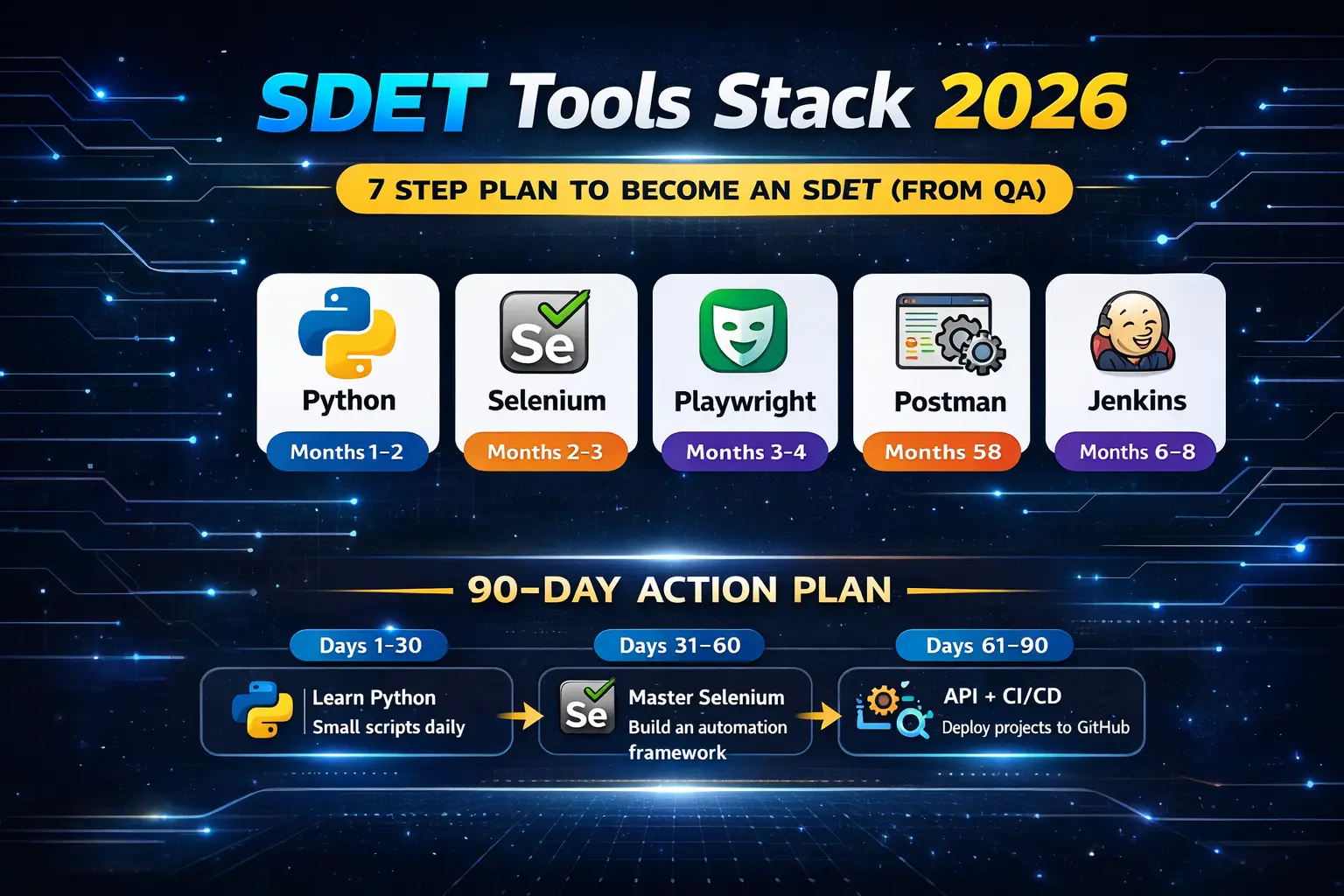
Here is the complete tools stack and learning timeline for SDETs in 2026:
SDET Salary in 2026
Salaries vary by location and experience. Here is what the market looks like in 2026.
Remote roles:
- Junior SDET: $800–$1,500 per month
- Mid-level SDET: $1,500–$3,000 per month
- Senior SDET: $3,000–$5,000 per month
On-site roles:
- USA: $95,000–$145,000 per year
- UK: £55,000–£85,000 per year
- Canada: CAD $85,000–$120,000 per year
Remote SDET roles offer high ROI for engineers in developing countries. You can earn international salaries while working from home. See our full SDET Salary guide for a complete breakdown by experience level.
Common Mistakes to Avoid
1. Learning too many tools at once. Pick Python. Pick Selenium. Build something real. Then move to the next tool. Do not jump between Java, Python, Cypress, and Playwright at the same time.
2. Only watching tutorials. Tutorials give you zero interview credibility. Build real projects, push them to GitHub, and write about what you built.
3. Skipping framework design. Writing individual test scripts is not SDET work. Learning POM and framework design is what separates SDETs from automation testers.
4. Ignoring API testing. In 2026, every SDET role requires API testing knowledge. Do not skip Stage 4.
5. No GitHub presence. Recruiters check GitHub before interviews. An empty GitHub profile kills your chances even if your resume looks strong.
6. Skipping the mindset shift. Tools are learnable in months. The shift-left mindset and white-box testing approach take longer to develop. Focus on thinking like an engineer, not just a tester.
Real-World Example — From Manual QA to SDET in 9 Months
Here is how a QA engineer made the transition using this exact roadmap.
A manual tester with 2 years of black-box testing experience started learning Python in Month 1. They practiced 12 hours per week using free resources. By Month 3 they had a Selenium POM framework running on GitHub with GitHub Actions CI/CD integrated.
By Month 6 they added REST Assured API tests to the same framework. This covered both UI and API layers in one project. By Month 9 they had three portfolio projects — a web automation framework, an API test suite, and a BDD project using Cucumber.
They applied to 14 SDET roles and received 6 interview callbacks. Their GitHub portfolio was mentioned positively in 4 of those interviews.
The result: first SDET role secured at Month 11. No CS degree. No bootcamp. Just consistent daily practice and real projects on GitHub.
Your 90-Day Action Plan
Days 1–30:
- Learn Python basics — 1 hour daily
- Complete 30 Python exercises on HackerRank
- Set up Selenium and run your first automated test
Days 31–60:
- Build your Selenium POM framework
- Write 20 automated test cases
- Create your GitHub account and push your first project
Days 61–90:
- Learn API testing with Postman and Python Requests
- Add GitHub Actions to your existing project
- Start applying to junior SDET roles
Final Thoughts
By following this roadmap, you now understand exactly how to become an SDET from scratch.The path to becoming an SDET is straightforward: Python, Selenium, API testing, CI/CD, and real projects on GitHub.
You do not need a CS degree. You need consistency and real work that proves your skills.
Remote SDET roles offer high ROI for engineers in developing countries. You can earn international salaries while working from home. The investment is 9–12 months of focused practice.
Start with Stage 1 today. If you want a structured learning path alongside this guide, this Selenium WebDriver with Python course on Udemy covers the exact foundation you need.
For the tools SDETs are using in 2026, read our best AI testing tools guide.
Frequently Asked Questions
Can a manual QA engineer become an SDET without a CS degree?
Yes — and your QA background is a genuine advantage. You already understand testing concepts, bug reporting, and test case design. You just need to add programming skills. Most QA engineers with testing knowledge become job-ready SDETs within 9–12 months of consistent practice.
Which language should I learn first — Python or Java?
Start with Python. It has easier syntax, is faster to learn, and is the primary language for 70% of new automation frameworks in 2026. Java remains important for enterprise SDET roles. Learn Python first, then add Java basics once you have a working Selenium framework built.
Is Selenium still relevant in 2026?
Yes. Selenium 4 is actively maintained and used by over 80% of enterprise automation teams. Playwright is growing fast as a modern alternative. Learning both gives you a significant advantage — start with Selenium, then add Playwright basics once your foundation is solid.
How long does it take to become a job-ready SDET?
It takes 9–12 months with 10–15 hours of practice per week. QA engineers with existing testing knowledge reach a job-ready level faster. Building real GitHub projects and applying to junior SDET roles at the 9-month mark is the recommended approach.
Is SDET a developer or a tester role?
SDET is both. SDETs write production-quality code like developers and understand testing strategy like QA engineers. In 2026, the role is closer to a developer who specialises in quality engineering than a tester who has learned to code.
What is the difference between shift-left and shift-right testing?
Shift-left testing means involving SDETs early — reviewing requirements and designing tests before code is written. Shift-right testing means monitoring quality in production after deployment. Senior SDETs practice both. Most job descriptions in 2026 explicitly mention shift-left as a required skill.
Will AI replace SDET jobs?
No. Remote SDET jobs have grown by over 40% since 2023. AI tools speed up script writing but cannot replace engineering judgment. SDETs who understand how to test AI products — including LLM validation and hallucination detection — are the most in-demand engineers in the testing field in 2026.
Do SDETs need to know LeetCode-style algorithms?
Basic LeetCode at the Easy level is sufficient for most SDET roles. You will face string manipulation, array problems, and simple OOP design questions. You do not need to solve Hard-level algorithm problems unless targeting top-tier companies like Google or Meta.
What is white-box testing, and why do SDETs need it?
White-box testing requires reading internal code and writing tests that cover specific logic paths and code branches. Unlike black-box testing, it requires programming skills. SDETs need it because they are responsible for code-level quality — not just functional validation from a user perspective.
What is the fastest way to learn how to become an SDET?
Focus on one tool at a time. Learn Python for 30 days, then Selenium, then API testing. Build a real project at each stage and push it to GitHub. Consistency beats speed — 1 hour daily beats 7 hours on weekends. Having a working CI/CD pipeline on your GitHub profile before your first interview is the single biggest differentiator.