Almost every QA team now uses AI in software testing, but the results are uneven. Some uses save real time; others create tests that look right and are not. This guide sorts the six main uses by how much evidence supports them, using six surveys published between September 2025 and November 2026, and says plainly what we did and did not test ourselves.
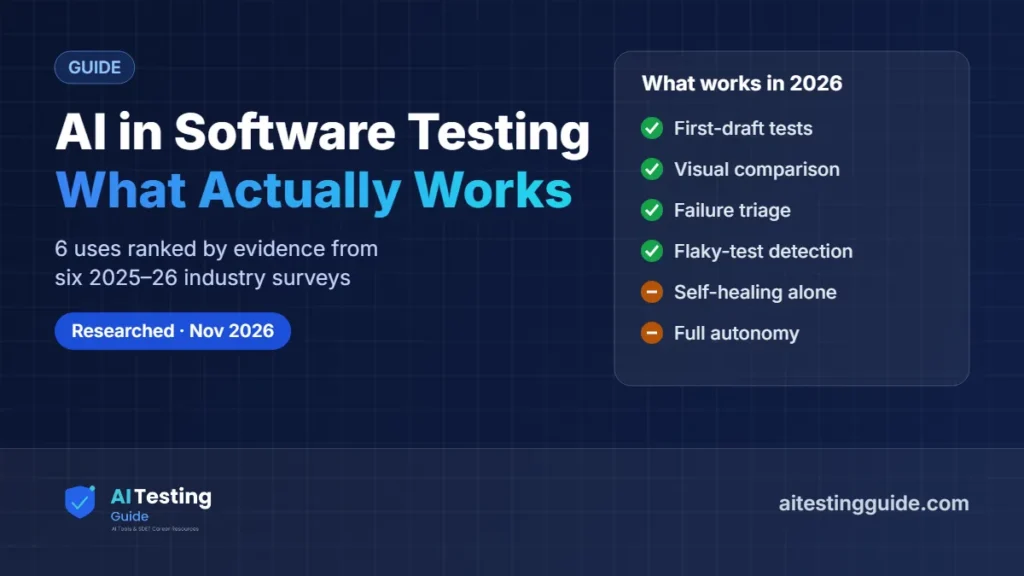
AI in software testing works best in 2026 for first-draft test cases, visual comparison, failure triage and flaky-test detection. It works worst as a fully autonomous tester. In BrowserStack’s February 2026 survey, 94% of teams used AI in testing but only 12% had reached full autonomy. Use AI to speed people up, and keep a person reviewing what it produces.
If you are comparing AI tools with scripted frameworks such as Selenium or Playwright, read AI test automation vs traditional automation. If you are worried about your job, read will AI replace QA engineers. This page answers a different question: which uses of AI in testing actually work?
Table of Contents
Table of Contents
What is AI in software testing?
AI in software testing means using machine learning or large language models (LLMs) to help with testing work. In practice it covers six different jobs that vendors often blur together:
- Generating tests: writing test cases or automation scripts from a requirement, user story or page.
- Self-healing locators: repairing a test when a button or field selector changes.
- Visual comparison: spotting meaningful changes between screenshots while ignoring noise.
- Agentic exploration: an AI agent clicking through an app on its own to find problems (see agentic testing).
- Failure triage: explaining why a test failed and grouping similar failures.
- Test selection and flake detection: choosing which tests to run for a change and flagging tests that fail at random.
These six have very different track records, so judge each one on its own. (The six-way split follows a breakdown published by TestingBot, which we reworded; see Sources.)
How many teams use AI in software testing in 2026?
Roughly nine in ten teams use AI somewhere in testing, but only a small share run it at scale or without people. Six recent surveys agree on that pattern:
| Survey (publisher) | Published | Who answered | Key finding |
|---|---|---|---|
| DORA State of AI-assisted Software Development (Google) | 23 Sep 2025 | Nearly 5,000 technology professionals | 90% use AI at work; only 24% trust it a lot or a great deal |
| World Quality Report 2025 (Capgemini, OpenText) | 13 Nov 2025 | 2,000+ senior executives, 22 countries | 89% pilot or deploy Gen AI in quality engineering; only 15% have scaled it enterprise-wide |
| State of AI in Software Testing (BrowserStack) | 10 Feb 2026 | 250+ testing leaders | 94% use AI in testing; 12% reached full autonomy |
| State of Digital Quality (Applause) | 9 Oct 2026 | uTest community and other QA, dev and AI staff (size not stated) | 92% use AI in testing; 29% report more or worse defects |
| State of AI in Quality Engineering (TestMu AI) | Nov 2026 | Its own community, 58% QA practitioners (size not stated) | Median trust in AI-generated test artifacts: 54 out of 100 |
| State of DevOps: AI in Testing (Perforce) | 2026 | 820 IT decision-makers and DevOps practitioners | 66% report higher total testing costs since adopting AI |
The gap between “using AI” and “AI at scale” is the most consistent finding. The World Quality Report found 37% in production and 52% still piloting, and BrowserStack named integrating AI tools as the top challenge (37% of respondents).
Which uses of AI in testing actually work?
First-draft test generation, visual comparison and failure triage have the strongest support today; full autonomy and self-healing as a cure-all have the weakest. Here is each use with the evidence behind it:
| Use | Evidence | Our verdict (13 Nov 2026) |
|---|---|---|
| Generating test cases and scripts | Most common use: 65% use AI to create test cases and 62% to write automation scripts (Applause) | Works as a first draft. TestMu respondents say AI tests are “almost right, but not quite” a median 65% of the time, so review every one. |
| Visual comparison | The most mature category (TestingBot); see our AI visual testing tools | Works. Managing baselines takes most of the effort. |
| Failure triage | Vendor and practitioner reports; no survey figure found | Works, low risk. A wrong suggestion is cheap to ignore. |
| Test selection and flake detection | Vendor reports; no survey figure found | Promising. Keep a scheduled full run so skipped tests do not hide bugs. |
| Self-healing locators | Vendor claims only; no independent figures found | Use with care. It can hide real regressions. Stable test IDs fix the cause. |
| Agentic exploration and full autonomy | 12% at full autonomy (BrowserStack); 10% let an agent write, run and judge tests (TestMu) | Early. A good source of test ideas, not a replacement for a maintained suite. |
A practical example: ask an AI tool to draft test cases from a user story, then delete the ones that check nothing useful and run the rest against a build with a known bug. If no test fails, the tests are not doing their job. Our guide on writing test cases with AI walks through this step by step.
Where does AI in software testing fall short?
AI in testing falls short on trust, cost and quality control. The surveys show the same warning signs from different angles:
- Trust is low. Only 24% of DORA respondents trust AI a lot or a great deal, and TestMu’s median trust in AI-generated test artifacts is 54 out of 100.
- Unchecked AI output is getting merged. 81% of TestMu respondents have merged AI-written code or tests they did not fully understand, and only 41% run any automated check on AI-written code before merge.
- Defects can rise. 29% of Applause respondents and 44% of TestMu respondents report more defects or production incidents as AI use grew.
- Costs can go up, not down. 66% of Perforce respondents report higher total testing costs since adopting AI, and a third of World Quality Report respondents saw minimal productivity gains (the average was 19%).
- Privacy and reliability worry leaders. The World Quality Report lists data privacy (67%), integration complexity (64%) and hallucinations (60%) as the top challenges.
- Deciding what to test is still human work. 86% of Applause respondents call human involvement extremely important.
There is also a new testing job: the AI features themselves. TestMu found 72% of respondents have AI features in production, and 37% of teams building AI agents have no systematic way to evaluate them. For that work, see how to test an AI chatbot and prompt injection testing.
How do you start using AI in software testing?
Start with one painful task, measure it, and keep a person reviewing the output. A five-step plan:
- Pick one pain point, such as slow test writing, flaky builds or long triage, not “AI testing” in general.
- Trial one tool on your messiest area and count false alarms as well as hits. Our free AI testing tools list is a low-cost place to start, and best AI testing tools covers the paid ones we trialled.
- Add a review gate: every generated test must fail against a known bug before it joins the suite, and every self-heal gets a look.
- Write a one-page AI-use policy: which data may go to which tool. Applause found 66% of organisations have AI policies but only 20% call them clear and robust.
- Re-measure after a month and keep only what saved time without adding escaped bugs.
What we did and did not test
This article is researched, not a hands-on test. Every number comes from the six surveys above, read on 13 November 2026, and we did not run a head-to-head experiment for it, so there are no speed or accuracy figures of our own here. Where we have run tools ourselves, the result is on that tool’s page, for example our Promptfoo vs DeepEval comparison and our prompt injection test suite. We are not a testing vendor and none of the survey publishers paid for this page.
Sources and Versions Checked
- Google: How are developers using AI? Inside our 2025 DORA report (23 Sep 2025)
- Capgemini: World Quality Report 2025 press release (13 Nov 2025)
- BrowserStack: State of AI in Software Testing press release (10 Feb 2026)
- IT Brief UK: Applause 2026 State of Digital Quality coverage (9 Oct 2026)
- TestMu AI: State of AI in Quality Engineering 2026 (November 2026)
- Perforce: State of DevOps, AI in Testing 2026
- TestingBot: AI in software testing, what actually works (vendor article, used for the six categories)
All sources were read on 13 November 2026.
Frequently Asked Questions
What does AI in software testing mean?
It is the use of machine learning or large language models to help with testing tasks: writing tests, comparing screens, repairing broken locators, triaging failures, exploring an app, and choosing which tests to run.
How is AI used in software testing today?
Mostly to create test cases and automation scripts. Applause’s October 2026 survey found 65% use it for test cases, 62% for scripts and 48% to find coverage gaps.
Will AI replace software testers?
Current surveys do not point that way: 86% of Applause respondents say human involvement in testing is extremely important, and only 12% of BrowserStack respondents reached full autonomy. See will AI replace QA engineers.
Can I trust AI-generated test cases?
Only after review. TestMu respondents say AI-generated tests are “almost right, but not quite” a median 65% of the time. Make every generated test fail against a known bug before you keep it.
Does AI make testing cheaper?
Not automatically. 66% of Perforce respondents report higher total testing costs since adopting AI, while the World Quality Report found an average productivity boost of 19% with a third seeing minimal gains.
What is the best AI tool for software testing?
It depends on the job: visual tools for UI changes, LLM assistants for drafting tests, evaluation tools for AI features. Our best AI testing tools page compares the ones we trialled.

QA automation engineer. Each guide says what I ran myself and what I only researched, and I update it when things change. About me
One useful email a week
New guides, tool price changes and AI testing news. No spam.