Last verified: September 2026. Both frameworks were evaluated using their current documentation, supported features, and common QA workflows.
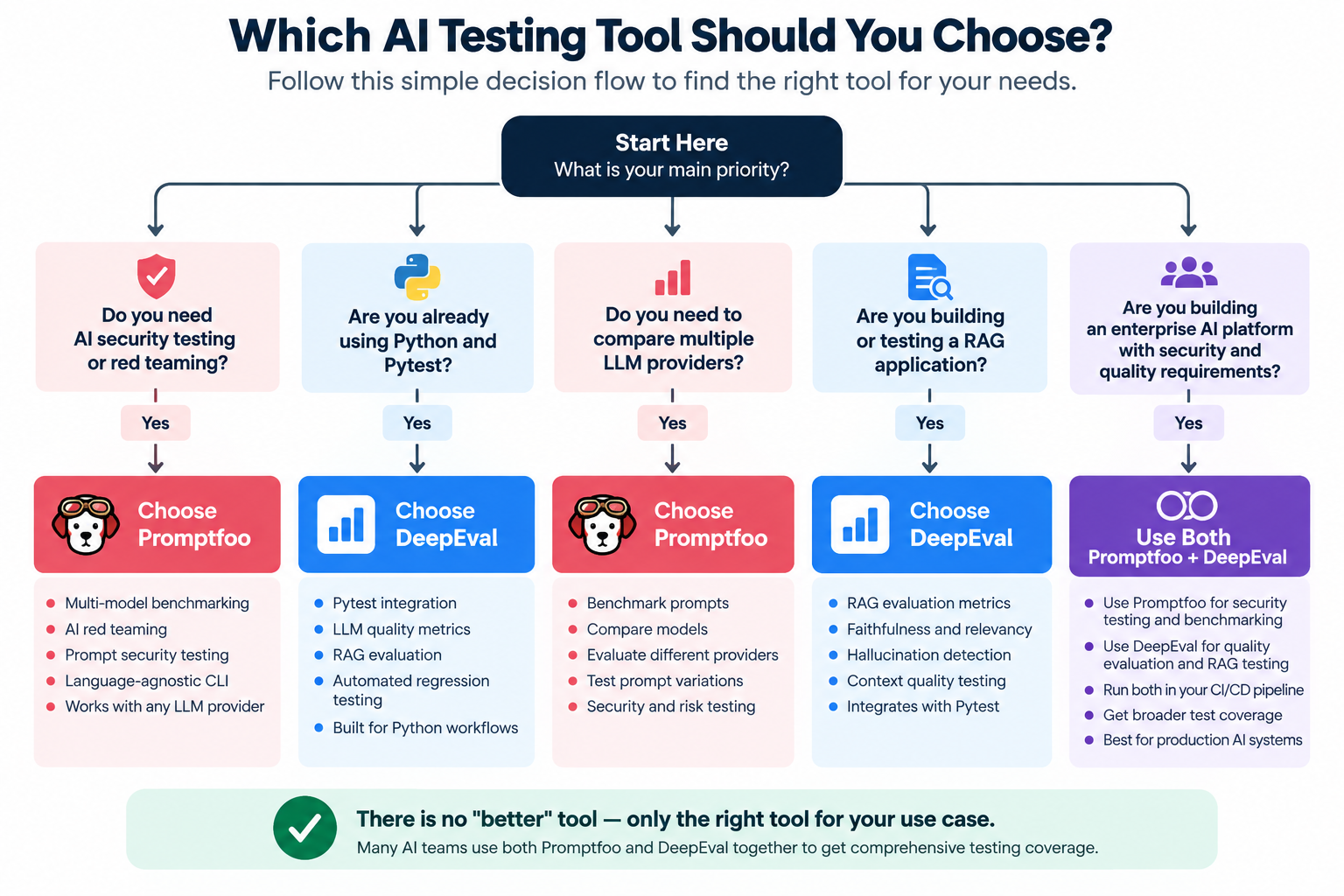
Quick answer: Promptfoo and DeepEval are both leading open-source LLM evaluation frameworks, but they solve different problems. Choose Promptfoo if you need multi-model benchmarking, automated red teaming, or a language-agnostic workflow. Choose DeepEval if you’re building Python applications, evaluating RAG systems, or want Pytest-style quality gates. Many production AI teams use both because they complement each other rather than compete.
Promptfoo and DeepEval are among the most widely adopted open-source AI testing frameworks in 2026. Although they’re often compared, they focus on different stages of the LLM testing lifecycle.
- Promptfoo (see the official Promptfoo documentation) is a CLI and YAML-based framework designed for prompt evaluation, multi-model benchmarking, and AI security testing through automated red teaming.
- DeepEval (see the official DeepEval documentation) is a Python-native evaluation framework focused on automated quality testing, RAG evaluation, AI agent testing, and Pytest-based CI/CD integration.
In this comparison, you’ll learn each framework’s strengths, limitations, ideal use cases, and when using both together is the better choice.
📚 Want a deeper dive?
- Read our Promptfoo Review for features, pricing, strengths, weaknesses, and our hands-on verdict.
- Read our DeepEval Review for an in-depth look at DeepEval’s architecture, evaluation metrics, and RAG testing capabilities.
- Follow the Promptfoo Tutorial to install Promptfoo, build your first evaluation, and integrate it into your CI/CD pipeline.
📌 Key Takeaways
- Choose Promptfoo if you need multi-model benchmarking, AI red teaming, prompt security testing, and a language-agnostic CLI workflow.
- Choose DeepEval if your team already uses Python and Pytest or needs built-in RAG evaluation metrics such as faithfulness, answer relevancy, and hallucination detection.
- Promptfoo excels at comparing multiple LLM providers, benchmarking prompts, and validating AI security before deployment.
- DeepEval is better suited for automated LLM quality testing, regression testing, and evaluating RAG applications within Python-based workflows.
- Both tools are open source, and many production AI teams use them together—Promptfoo for security and benchmarking, DeepEval for quality gates and RAG evaluation.
Table of Contents
Quick Verdict: Promptfoo vs DeepEval
If you just want the short answer, here’s what we recommend.
Choose Promptfoo if you:
- Need to compare prompts across multiple LLMs side by side.
- Want built-in red teaming with coverage for the OWASP LLM Top 10.
- Prefer a CLI and YAML-based workflow instead of writing Python code.
- Work on a team that uses multiple programming languages and frameworks.
Choose DeepEval if you:
- Build AI applications primarily in Python.
- Need comprehensive RAG evaluation with metrics like faithfulness, context precision, and context recall.
- Want LLM evaluations that integrate directly into your existing Pytest test suite.
- Test AI agents, tool-calling workflows, or multi-turn conversations.
Choose Both if you:
You’re building production AI applications and need end-to-end test coverage.
Use Promptfoo for prompt benchmarking, multi-model comparisons, and AI security testing. Use DeepEval for automated quality evaluation, RAG metrics, regression testing, and CI/CD quality gates.
Together, they provide broader coverage across the AI testing lifecycle than either framework can deliver on its own.
Bottom line: There isn’t a single winner. Promptfoo and DeepEval solve different testing challenges, and many experienced AI engineering teams use both as part of the same testing strategy.
Side-by-Side Comparison Table
If you’re deciding between Promptfoo and DeepEval, this comparison table highlights the key differences at a glance. Promptfoo excels at prompt benchmarking, multi-model evaluation, and AI security testing, while DeepEval is built for Python-native LLM testing, RAG evaluation, and automated quality metrics.
The detailed sections below explain each feature, when it matters, and which framework is the better choice for your workflow.
| Feature | Promptfoo | DeepEval |
|---|---|---|
| Primary workflow | CLI + YAML configuration | Python + Pytest |
| Best for | Multi-model benchmarking, red teaming, prompt evaluation | RAG evaluation, agent testing, LLM quality gates |
| Programming requirement | Node.js runtime (language-agnostic usage) | Python required |
| Test definition | Declarative YAML | Python test functions |
| Evaluation metrics | Assertions, LLM-as-a-Judge, and custom evaluators | 50+ research-backed metrics |
| Red teaming | ⭐⭐⭐⭐⭐ Built-in plugins, OWASP Top 10, jailbreak testing | ⭐⭐ Basic safety and bias evaluation |
| RAG evaluation | ⭐⭐ Basic (custom providers) | ⭐⭐⭐⭐⭐ Faithfulness, precision, recall, relevancy |
| AI agent evaluation | ⭐⭐ Limited | ⭐⭐⭐⭐⭐ Multi-turn agents, tool calls, task completion |
| Multi-model comparison | ⭐⭐⭐⭐⭐ Native side-by-side matrix | ⭐⭐ Manual implementation |
| CI/CD integration | Works with GitHub Actions and any CI platform via CLI | Native Pytest integration with any Python CI pipeline |
| Web interface | Local evaluation viewer | Confident AI dashboard (optional) |
| License | MIT License | Apache 2.0 |
| Learning curve | Easy for teams already using YAML | Easy for teams already using Python and Pytest |
| Ideal user | QA Engineers, SDETs, security-focused teams | Python developers, SDETs, ML engineers, and RAG teams |
Quick takeaway: Choose Promptfoo if your priority is prompt evaluation, multi-model benchmarking, and AI security testing. Choose DeepEval if you need Python-native testing, RAG evaluation, and automated quality metrics. Many production AI teams use both because they solve different testing problems.
Which Is Easier to Start With?
Both Promptfoo and DeepEval are quick to install, but the easier framework depends on your team’s existing tools, programming languages, and testing workflow.
Promptfoo
Promptfoo is generally the easier choice for QA engineers and cross-functional teams because it uses a simple YAML configuration instead of Python code. If your team already works with GitHub Actions, Docker, Kubernetes, or other YAML-based tools, you’ll feel comfortable with Promptfoo almost immediately.
It’s also a strong option for organizations using Java, JavaScript, C#, Go, or multiple programming languages because it doesn’t require a Python-based testing stack.
DeepEval
DeepEval is the more natural fit for Python teams. It integrates directly with Pytest, allowing developers to add LLM evaluation to existing Python test suites without introducing a separate configuration format.
If your team already builds APIs, automation frameworks, or AI applications in Python, adopting DeepEval usually feels like extending your current testing practices rather than learning a completely new tool.
Our recommendation: If your team is Python-first, start with DeepEval. If you need a language-agnostic framework for prompt evaluation, multi-model benchmarking, and AI security testing, Promptfoo is typically the easier place to begin.
Which Is Better for QA Engineers?
For most QA engineers and SDETs, Promptfoo is the better starting point because its workflow closely mirrors traditional software testing. Instead of writing Python code, you define test cases, variables, assertions, and expected behavior in YAML, making test suites easy to review, maintain, and integrate into CI/CD pipelines.
Promptfoo also makes it easy to:
- Compare prompts across multiple LLMs side by side.
- Run automated red team tests against common AI security risks.
- Validate prompt changes before they reach production.
- Share reusable test configurations across teams, regardless of their programming language.
DeepEval is an excellent choice for QA engineers who already work primarily in Python. Its Pytest-based framework fits naturally into existing automation projects and provides advanced evaluation metrics for RAG systems, AI agents, and production AI applications.
However, if your team needs multi-model comparisons, language-agnostic testing, or a lower barrier to entry for non-Python testers, Promptfoo is usually the easier framework to adopt.
Our recommendation: If your goal is to bring established QA practices into LLM testing with minimal friction, start with Promptfoo. If your team already has a mature Python automation framework and focuses on RAG evaluation or AI agents, DeepEval is an excellent addition to your testing toolkit.
For a broader introduction to AI quality assurance, read our How to Test LLM Applications guide.
Which Is Better for Python Teams?
For Python-first engineering teams, DeepEval is the stronger choice. It was built specifically for Python developers and integrates directly with Pytest, making it easy to add LLM evaluations to your existing test suites with minimal changes.
Instead of learning a separate workflow, developers can write LLM tests using familiar Python syntax, reuse existing CI/CD pipelines, and extend their current automation frameworks. This makes DeepEval especially appealing for teams building AI applications, RAG systems, AI agents, and other Python-based LLM projects.
from deepeval import assert_test
from deepeval.test_case import LLMTestCase
from deepeval.metrics import AnswerRelevancyMetric

def test_chatbot_response():
    test_case = LLMTestCase(
        input="What is your return policy?",
        actual_output="We offer 30-day returns on all items.",
        retrieval_context=["ShopFlow return policy: 30-day returns."]
    )

    metric = AnswerRelevancyMetric(threshold=0.7)
    assert_test(test_case, [metric])
Promptfoo also works well in Python projects, but its primary workflow is based on a Node.js CLI and YAML configuration. While this approach is ideal for polyglot engineering teams and organizations that support multiple programming languages, Python-only teams often find DeepEval to be a more natural fit because it extends tools they already use.
Bottom line: If your team already builds and tests applications in Python, DeepEval is the better choice. If your organization supports multiple programming languages or prioritizes prompt benchmarking, multi-model evaluation, and AI security testing, Promptfoo offers greater flexibility.
Want to learn more? Read our DeepEval Review for a hands-on walkthrough of its features, evaluation metrics, real-world examples, and best practices.
Which Is Better for RAG Evaluation?
For teams building Retrieval-Augmented Generation (RAG) applications, DeepEval is the stronger choice. Unlike frameworks that focus primarily on the final generated response, DeepEval evaluates both retrieval quality and generation quality using research-backed metrics.
DeepEval includes built-in metrics such as:
- Faithfulness – Does the generated response accurately reflect the retrieved documents?
- Context Precision – How relevant are the retrieved documents to the user’s query?
- Context Recall – Were all relevant documents successfully retrieved?
- Answer Relevancy – Does the final response directly answer the user’s question?
These metrics help engineering teams determine whether failures originate from the retrieval layer, the LLM, or the overall RAG pipeline, making debugging and optimization much easier.
Promptfoo can also evaluate responses generated by RAG applications, but it primarily validates the final output rather than analyzing retrieval quality. For many general LLM evaluation workflows, that’s sufficient. However, teams building production-grade RAG systems typically need the deeper retrieval metrics that DeepEval provides.
Our recommendation: If your application depends on accurate document retrieval, grounded responses, and measurable RAG quality, DeepEval is the better choice. If your primary goal is prompt evaluation, multi-model benchmarking, or AI security testing, Promptfoo remains an excellent option.
Recommended Reading
- DeepEval Review — Learn how DeepEval evaluates RAG systems, AI agents, and production LLM applications.
- What Is RAGAS? Testing RAG Pipelines Explained for QA Engineers — Understand the metrics, concepts, and best practices behind evaluating retrieval quality in RAG applications.
Which Is Better for Red Teaming and AI Security?
When it comes to AI red teaming and security testing, Promptfoo is the clear winner. It includes more than 50 built-in vulnerability plugins aligned with the OWASP Top 10 for LLM Applications, covering common risks such as prompt injection, jailbreaks, sensitive data leakage, harmful content generation, SSRF, BOLA, and other AI security vulnerabilities.
Instead of manually crafting adversarial prompts, Promptfoo lets you initialize a red team project, define your target application, and automatically generate attack prompts, execute security tests, and produce a severity-scored vulnerability report.
# Initialize and run a red team scan
npx promptfoo@latest redteam init my-security-scan
cd my-security-scan
npx promptfoo@latest redteam run
DeepEval includes evaluation metrics for safety, toxicity, bias, and hallucination detection, but these focus on measuring model outputs rather than simulating real-world adversarial attacks. If your organization needs security validation before production deployment, compliance testing, or enterprise AI governance, Promptfoo provides a more comprehensive security testing workflow.
Our recommendation: Choose Promptfoo if AI security, red teaming, or compliance testing is a priority. Choose DeepEval if your primary focus is evaluating model quality, RAG systems, or AI agent performance rather than identifying security vulnerabilities.
Recommended Reading
- Promptfoo Review — Explore Promptfoo’s red teaming features, security plugins, and real-world use cases.
- Promptfoo Tutorial — Learn how to build your first automated AI security testing workflow.
- Hallucination Testing Guide — Understand how to test AI systems for hallucinations, unsafe outputs, and other common LLM failure modes.
Which Is Better for CI/CD Integration?
Both Promptfoo and DeepEval integrate well with CI/CD pipelines, but they take different approaches.
Promptfoo
Promptfoo runs as a standalone CLI, making it easy to integrate with virtually any CI platform, including GitHub Actions, GitLab CI, Azure DevOps, Jenkins, CircleCI, and Buildkite. Simply run your evaluation as part of the pipeline, and Promptfoo can fail the build if assertions or evaluation thresholds aren’t met.
This language-agnostic approach is especially valuable for organizations with Java, JavaScript, Go, C#, or mixed-language codebases because it doesn’t require a Python testing framework.
DeepEval
DeepEval integrates directly with Pytest, making it a natural fit for Python teams. If your CI pipeline already runs Pytest, you can add LLM evaluations alongside your existing unit, integration, and end-to-end tests without introducing a separate testing workflow.
This allows AI quality checks to appear in the same test reports developers already use, simplifying regression testing and release validation.
Our recommendation: If your CI pipeline is already built around Python and Pytest, DeepEval provides the smoothest integration. If your organization supports multiple programming languages or prefers a standalone evaluation workflow, Promptfoo offers greater flexibility across different CI/CD platforms.
Which Is Better for Multi-Model Comparison?
If your goal is to compare multiple LLMs side by side, Promptfoo is the clear winner. Multi-model benchmarking is one of Promptfoo’s defining features.
Simply list multiple model providers in your YAML configuration, and Promptfoo automatically runs the same evaluation suite against every model. The results are presented in a side-by-side comparison, making it easy to evaluate:
- Response quality
- Accuracy
- Latency
- Cost
- Token usage
- Pass/fail rates across evaluation metrics
providers:
  - openai:chat:gpt-4o-mini
  - openai:chat:gpt-4o
  - anthropic:messages:claude-sonnet-4-6
This is especially valuable when choosing a model for production, validating new model releases, or measuring performance before switching providers.
DeepEval can evaluate multiple models, but it doesn’t provide a built-in comparison matrix. Instead, you’ll typically create separate test runs or parameterize your Pytest suites and compare the results manually.
Our recommendation: If your team regularly compares OpenAI, Anthropic, Google, or other LLM providers, Promptfoo dramatically simplifies the evaluation process. If you’re primarily testing a single production model inside a Python application, DeepEval is usually sufficient.
Recommended Reading
- Best AI Testing Tools — Compare the leading AI testing and LLM evaluation frameworks.
- Promptfoo Review — Explore Promptfoo’s benchmarking, evaluation, and red teaming capabilities in depth.
How Do They Compare on Cost and Maintenance?
Both Promptfoo and DeepEval are open-source frameworks and are free to use. In practice, the biggest ongoing expense isn’t the framework itself—it’s the LLM API calls generated during your evaluation runs.
| Cost Factor | Promptfoo | DeepEval |
|---|---|---|
| License | Free (MIT License) | Free (Apache 2.0 License) |
| API costs | Pay per evaluation run (LLM calls + LLM-as-a-Judge calls) | Pay per evaluation run (LLM calls + evaluation metric calls) |
| Caching | Built-in response caching | Supported through configuration |
| Enterprise platform | Promptfoo Team ($50/month) | Confident AI (custom pricing) |
| Project stewardship | Maintained by OpenAI (MIT licensed) | Independently maintained (Apache 2.0) |
| Vendor lock-in | Low—supports OpenAI, Anthropic, Google, local models, and custom providers | Low—open source and provider-agnostic |
💡 Tip: Before running large benchmark suites across multiple models, estimate your expected API usage. Evaluating hundreds of prompts against several LLMs can generate thousands of model calls, making API costs significantly higher than the frameworks themselves.
Our recommendation: Choose the framework that best fits your workflow rather than focusing on licensing costs. Both are free, actively maintained, and designed to work with multiple LLM providers. Your engineering time and API usage will typically have a much greater impact on total cost than the framework itself.
Note on OpenAI’s acquisition of Promptfoo: OpenAI acquired Promptfoo in 2026, but the project remains open source under the MIT License and continues to support multiple model providers, including Anthropic, Google, OpenAI, and self-hosted models. Teams with strict vendor-neutrality requirements may still prefer an independently governed project such as DeepEval.
For a detailed analysis of the acquisition and what it means for engineering teams, read our Promptfoo Review.
Which One Should You Choose? Recommendations by Role
If you skipped straight to the conclusion, here’s the short answer. The best framework depends on your role, tech stack, and what you’re trying to evaluate.
| If you are a… | Start with… | Why |
|---|---|---|
| QA Engineer | Promptfoo | YAML-based tests closely match traditional QA workflows. Built-in multi-model benchmarking and red teaming make it easy to start testing LLM applications without writing Python. |
| Python SDET | DeepEval | Integrates directly with Pytest, allowing you to add LLM evaluations to your existing Python test suite with minimal changes. |
| SDET (Java, C#, JavaScript) | Promptfoo | Language-agnostic CLI works across polyglot environments without requiring a Python-based testing framework. |
| Automation Engineer | Promptfoo | CLI-first workflow integrates easily into CI/CD pipelines and version-controlled test suites. |
| Python Developer | DeepEval | Code-first approach feels like a natural extension of existing Python testing practices. |
| AI Test Engineer | Both | Use Promptfoo for benchmarking, red teaming, and security testing. Use DeepEval for RAG evaluation, AI agents, and advanced quality metrics. |
| Team building RAG applications | DeepEval | Built-in metrics such as Faithfulness, Context Precision, Context Recall, and Answer Relevancy make it the better choice for evaluating retrieval quality. |
| Team focused on AI security | Promptfoo | Industry-leading red teaming capabilities, automated attack generation, and broad OWASP LLM vulnerability coverage. |
| New to AI testing | Promptfoo | Lower learning curve, language-agnostic configuration, and an intuitive comparison interface make it an excellent starting point. |
Final recommendation: If you’re coming from a traditional QA or test automation background, start with Promptfoo. If you’re building AI applications in Python—especially RAG systems or AI agents—start with DeepEval. Many mature engineering teams eventually use both because they solve different parts of the AI testing lifecycle.
When Should You Use Promptfoo and DeepEval Together?
Promptfoo and DeepEval aren’t direct competitors—they solve different problems in the AI testing lifecycle. Many engineering teams use both to build a layered evaluation strategy.
1. Before Every Merge: Promptfoo for AI Security
Whenever a developer updates a system prompt, retrieval logic, or model configuration, Promptfoo runs automated red team tests in the CI pipeline. It checks for vulnerabilities such as:
- Prompt injection
- Jailbreak attacks
- Sensitive data leakage
- Harmful or unsafe outputs
- Other OWASP Top 10 for LLM Applications risks
If critical vulnerabilities are detected, the pipeline can block the deployment before the changes reach production.
2. Before Every Merge: DeepEval for Quality Regression
During the same CI pipeline, DeepEval validates response quality using metrics such as:
- Answer Relevancy
- Faithfulness
- Context Precision
- Context Recall
- Hallucination detection
These tests answer a critical question:
Did this change reduce the quality of our AI application?
This is the AI equivalent of regression testing in traditional software development.
3. Before Choosing a New Model: Promptfoo for Benchmarking
When evaluating a new model—for example, deciding whether to migrate from GPT-4o to Claude Sonnet—Promptfoo runs the same evaluation suite against multiple providers.
The side-by-side comparison helps teams evaluate:
- Response quality
- Latency
- API cost
- Pass rates
- Overall performance
This is typically performed during technology evaluations rather than on every CI run.
4. After Deployment: DeepEval for Continuous RAG Evaluation
When the knowledge base changes—for example, after adding new documentation, updating policies, or refreshing indexed content—DeepEval verifies that retrieval quality hasn’t degraded.
Engineering teams often monitor metrics such as Faithfulness, Context Precision, and Context Recall over time to detect regressions before users notice them.
Bottom line: Mature AI engineering teams don’t choose between Promptfoo and DeepEval—they use each framework where it provides the greatest value. Promptfoo protects applications through benchmarking and AI security testing, while DeepEval continuously measures response quality and RAG performance throughout the development lifecycle.
Frequently Asked Questions
Can Promptfoo and DeepEval be used together?
Yes. Promptfoo and DeepEval run independently and complement each other rather than conflict.
Many engineering teams use Promptfoo for security testing, red teaming, and multi-model benchmarking, while using DeepEval for quality regression testing, RAG evaluation, and automated metrics. Running both in the same CI/CD pipeline provides broader coverage across the AI testing lifecycle.
Which tool has better documentation?
Both projects provide excellent documentation, but they target different audiences.
Promptfoo’s documentation is organized around CLI workflows, YAML configuration, benchmarking, and red teaming. DeepEval’s documentation follows a Python-first approach with Pytest examples, evaluation metrics, and AI application testing.
If you’re already comfortable with Python, DeepEval’s documentation will likely feel more familiar. If you prefer configuration over writing code, Promptfoo’s documentation is generally easier to follow.
Does Promptfoo work without Node.js?
No. Promptfoo requires Node.js (v22 or later) to run its CLI.
However, you don’t need to write JavaScript. Most users interact with Promptfoo through YAML configuration files and CLI commands, making it suitable for teams working with Java, Python, C#, Go, or other programming languages.
Is DeepEval harder to learn than Promptfoo?
It depends on your background.
If you already use Python and Pytest, DeepEval has a short learning curve because it integrates directly into your existing test suite.
If your team doesn’t use Python, Promptfoo is typically easier to adopt because most evaluations are defined in YAML rather than code.
The learning curve depends more on your current development stack than on either framework itself.
Which framework appears more often in job postings?
Both are becoming valuable skills, but they appear in different types of roles.
Promptfoo is increasingly mentioned in AI Test Engineer, QA Automation, and LLM evaluation roles because of its benchmarking and red teaming capabilities.
DeepEval is commonly requested for Python-focused AI engineering, RAG development, and production LLM applications.
Senior AI testing roles increasingly value familiarity with both frameworks.
Should I worry about Promptfoo’s OpenAI acquisition?
For most teams, no.
Promptfoo remains open source under the MIT License and continues to support multiple model providers, including OpenAI, Anthropic, Google, and local models.
Organizations with strict vendor-neutrality requirements may still prefer DeepEval because it is independently maintained, but there is currently no indication that Promptfoo has become OpenAI-exclusive.
What about RAGAS? Where does it fit?
RAGAS is a RAG evaluation library, not a complete LLM testing framework.
If your primary goal is evaluating retrieval quality, RAGAS provides specialized metrics such as faithfulness, context precision, and context recall.
DeepEval already includes many RAG-focused evaluation metrics, so many Python teams can use DeepEval without adding RAGAS separately.
If you’re using Promptfoo and need advanced RAG evaluation, pairing it with either DeepEval or RAGAS is a common approach.
Learn more in our What Is RAGAS? guide.
Final Recommendation
Final Recommendation
Short answer: Neither Promptfoo nor DeepEval is universally better. The right choice depends on your team’s technology stack, testing goals, and workflow.
- Choose Promptfoo if you need multi-model benchmarking, automated red teaming, security testing, or a language-agnostic workflow.
- Choose DeepEval if you’re building Python-based AI applications, evaluating RAG systems, or integrating LLM quality checks into existing Pytest suites.
- Use both if you’re building production AI systems. Promptfoo excels at benchmarking and security testing, while DeepEval provides deeper quality evaluation and regression testing.
The biggest mistake isn’t choosing the “wrong” framework—it’s shipping AI applications without systematic evaluation. Start with the framework that best fits your current stack, then expand your testing strategy as your AI applications mature.
If you’re new to AI quality assurance, start with our How to Test LLM Applications guide to understand the complete AI testing workflow before selecting evaluation tools.