DeepEval vs RAGAS is the most common decision QA engineers face when they start testing LLM and RAG applications in 2026 — and most comparison articles are written by the tool vendors themselves, so they are biased. This is the SDET perspective: which framework to actually use, when, and why, with the cost and CI/CD details vendors leave out.
We also bring TruLens into the comparison, because “DeepEval vs RAGAS vs TruLens” is how the decision really looks once you include production monitoring. Here is the complete breakdown.
What is the difference between DeepEval and RAGAS?
DeepEval is a general-purpose, Pytest-native LLM evaluation framework built for CI/CD pipelines, custom metrics, and testing chatbots and AI agents. RAGAS is a specialized, research-grade library built strictly for evaluating RAG pipelines without needing ground-truth answers. Use DeepEval when you need automated test gates and agent testing; use RAGAS for focused RAG retrieval and generation evaluation. TruLens is the third option, best for continuous production monitoring with its TruLens Triad metrics.
Key Takeaways
- DeepEval is a Pytest-native testing ecosystem — best for SDETs building CI/CD quality gates, custom metrics, and agent or chatbot testing.
- RAGAS is a focused RAG evaluation library — best for fast, reference-free retrieval and generation scoring.
- TruLens is an observability tool — best for continuous production monitoring using its Triad of context relevance, groundedness, and answer relevance.
- All three use the LLM-as-a-judge approach, which means real token cost per evaluation run.
- You can run RAGAS metrics inside DeepEval — they are not strictly either/or.
Table of Contents
DeepEval vs RAGAS vs TruLens — Quick Comparison
The fastest way to choose between DeepEval, RAGAS, and TruLens is to match the framework to your primary job: automated testing, RAG evaluation, or production monitoring. This table summarises the decision.
| Factor | DeepEval | RAGAS | TruLens |
|---|---|---|---|
| Primary use | CI/CD testing | RAG evaluation | Production monitoring |
| Pytest-native | Yes | No | No |
| Custom metrics | Yes (G-Eval) | Limited | Feedback functions |
| Agent testing | Yes | No | Partial |
| Reference-free | Yes | Yes | Yes |
| Best for | SDETs, QA teams | RAG researchers | MLOps teams |
| Cost | Free + cloud | Free | Free |
What Is DeepEval?
DeepEval is an open-source, Pytest-based LLM evaluation framework built by Confident AI for production testing workflows. It lets you write LLM tests the same way you write unit tests, with pass/fail thresholds that integrate directly into CI/CD pipelines.
DeepEval’s biggest strengths are its 14-plus built-in metrics, the G-Eval custom metric framework for scoring subjective traits like tone, and native support for testing AI agents and multi-turn chatbots. For SDETs, the Pytest integration is the killer feature — your LLM tests run like any other test in your suite. Read our full DeepEval review for the deep dive.
What Is RAGAS?
RAGAS (Retrieval Augmented Generation Assessment) is a specialized, open-source library built strictly for evaluating RAG pipelines without human-annotated ground truth. It is maintained by the ExplodingGradients team and is research-grade, focused, and lightweight.
RAGAS excels at the four core RAG metrics — faithfulness, answer relevancy, context precision, and context recall — and is the fastest way to validate a retrieval pipeline. Think of it as the focused specialist, where DeepEval is the full toolbox. See our guide on what RAGAS is for the complete explanation.
What Is TruLens?
TruLens is an open-source LLM observability and evaluation tool best known for the TruLens Triad — context relevance, groundedness, and answer relevance. It is designed for continuous monitoring of LLM applications in production rather than pre-deployment test gates.
TruLens shines when you need to track quality on live traffic over time using feedback functions. It is the monitoring layer, where DeepEval is the testing layer and RAGAS is the RAG evaluation layer.
How Do DeepEval and RAGAS Measure Faithfulness Differently?
DeepEval and RAGAS both measure faithfulness using LLM-as-a-judge, but they differ in strictness. RAGAS is stricter on logical, exact-fact entailment — it penalizes any claim not directly supported by the context. DeepEval is more pragmatic, weighing real-world truthfulness and subtle misrepresentation.
In practice this means RAGAS may flag a technically-correct answer as unfaithful if the phrasing drifts from the source, while DeepEval is more forgiving of paraphrasing that preserves meaning. Neither is “more correct” — RAGAS suits strict compliance testing, DeepEval suits real-world chatbot evaluation. For the underlying metric definitions, see our LLM evaluation metrics guide.
How Do You Test Faithfulness in DeepEval vs RAGAS? (Code)
The code difference shows the core philosophy: DeepEval wraps the test in a Pytest assertion, while RAGAS scores a dataset. Here is the same faithfulness check in both frameworks.
DeepEval — Pytest-native assertion:
from deepeval import assert_test
from deepeval.test_case import LLMTestCase
from deepeval.metrics import FaithfulnessMetric

def test_faithfulness():
    test_case = LLMTestCase(
        input="What is the return window?",
        actual_output="You can return items within 14 days.",
        retrieval_context=["Returns accepted within 14 days."]
    )
    metric = FaithfulnessMetric(threshold=0.8)
    assert_test(test_case, [metric])  # fails build if < 0.8
RAGAS — dataset scoring:
from ragas import evaluate
from ragas.metrics import faithfulness
from datasets import Dataset

data = Dataset.from_dict({
    "question": ["What is the return window?"],
    "answer": ["You can return items within 14 days."],
    "contexts": [["Returns accepted within 14 days."]]
})
result = evaluate(data, metrics=[faithfulness])
print(result)  # returns a faithfulness score
The key difference: DeepEval’s assert_test fails a CI/CD build automatically. RAGAS returns a score you then have to wrap in your own pass/fail logic. For SDETs building pipelines, that native assertion is why DeepEval wins on automation.
Which Is Better for CI/CD Pipelines?
DeepEval is better for CI/CD pipelines because it is Pytest-native and fails builds automatically when scores drop below threshold. RAGAS requires you to manually wrap its scores in pass/fail logic, adding engineering work to achieve the same gate.
This is the single biggest factor for QA engineers. With DeepEval, an LLM test is just another Pytest test in your existing suite — it runs in GitHub Actions with zero extra plumbing. See our GitHub Actions for test automation guide for the pipeline setup.
What About Token Cost and Speed?
Both DeepEval and RAGAS cost real money to run because LLM-as-a-judge consumes API tokens on every evaluation — a factor no vendor article discusses. Running 1,000 evaluations with GPT-4o as the judge can cost several dollars to tens of dollars depending on context length and number of metrics.
Practical cost-control tips that apply to both frameworks:
- Use a cheaper judge model (GPT-4o-mini) for routine runs, reserve the strong model for releases
- Run the full eval suite on releases, a small smoke subset on every commit
- Cache results for unchanged test cases
- Run fewer metrics per case — only the ones that matter for that test
This token cost is the hidden operating expense of LLM testing that teams discover only after their first big eval run. Budget for it.
Why Do I Get NaN Scores in RAGAS?
RAGAS returns NaN scores when the LLM judge fails to output strictly formatted JSON, which breaks the parsing function. This is a known brittleness in RAGAS, especially with smaller or non-OpenAI judge models that do not reliably follow JSON formatting.
DeepEval handles this more gracefully with stricter JSON confinement and error-handling retry loops, which is one of the practical reasons engineers cite for preferring it in production. If you hit NaN scores in RAGAS, switch to a more capable judge model or add retry handling around the evaluation call.
Can You Use DeepEval and RAGAS Together?
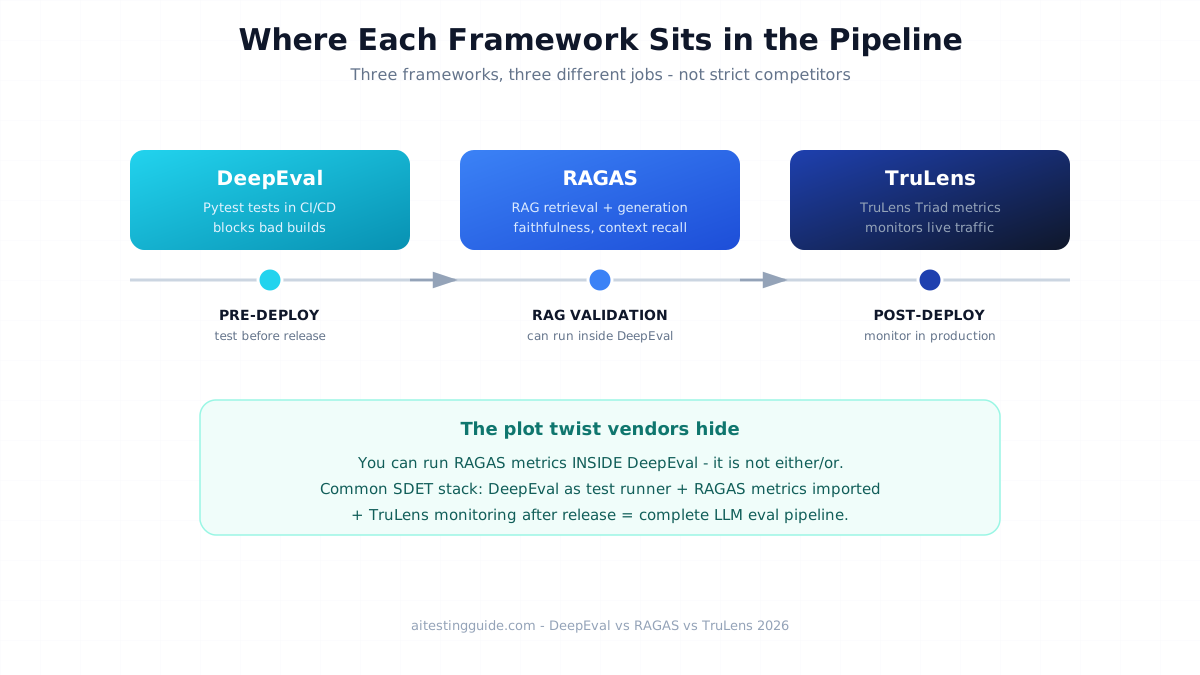
Yes, you can run RAGAS metrics inside DeepEval — they are not strictly an either/or choice. DeepEval lets you import RAGAS metrics natively, so you can use DeepEval’s Pytest framework and CI/CD integration while keeping RAGAS’s specific RAG scoring where you prefer it.
This interoperability is the plot twist most comparison articles miss. The smart play for many teams is DeepEval as the test runner and assertion layer, with RAGAS metrics imported for RAG-specific evaluation — the best of both. MLflow also integrates both as judges in one dashboard.
Which Should You Use? The SDET Verdict
Choose based on your primary job, and remember you can combine them. Here is the clear decision rule.
- Use DeepEval if you are an SDET or QA engineer building automated test gates in CI/CD, testing chatbots or AI agents, or need custom metrics. This is the default choice for testing teams.
- Use RAGAS if your job is specifically RAG pipeline evaluation and you want fast, focused retrieval and generation scoring without the full testing ecosystem.
- Use TruLens if you need continuous monitoring of LLM quality on live production traffic over time.
- Combine them if you want DeepEval’s CI/CD automation with RAGAS’s RAG metrics imported inside it.
For most QA engineers and SDETs reading this, DeepEval is the right starting point because it fits the testing workflow you already know. Add RAGAS metrics when you need deeper RAG evaluation. To build the testing skills that make either framework click, this Selenium WebDriver with Python course on Udemy covers the automation fundamentals, and our AI test engineer roadmap shows where this leads.
Disclosure: This article contains affiliate links. If you purchase through these links I earn a small commission at no extra cost to you.
Final Thoughts
The DeepEval vs RAGAS debate is not really a fight — they solve different problems. DeepEval is the Pytest-native testing ecosystem SDETs should reach for first, RAGAS is the focused RAG evaluation specialist, and TruLens is the production monitoring layer. The vendor articles frame it as either/or to sell their tool, but the truth is you can run RAGAS metrics inside DeepEval and get both.
For a QA engineer moving into AI testing in 2026, start with DeepEval for its CI/CD fit, learn RAGAS for RAG depth, and add TruLens when you reach production monitoring. Budget for the token cost, watch for RAGAS NaN errors, and you have a complete LLM evaluation stack.
Frequently Asked Questions
What is the difference between DeepEval, RAGAS, and TruLens in 2026?
DeepEval is a Pytest-native LLM testing framework for CI/CD and agent testing. RAGAS is a specialized library for RAG pipeline evaluation without ground truth. TruLens is an observability tool for continuous production monitoring using its Triad of context relevance, groundedness, and answer relevance. DeepEval suits testing teams, RAGAS suits RAG evaluation, TruLens suits MLOps monitoring.
Which framework is best for RAG evaluation: DeepEval, RAGAS, or TruLens?
RAGAS is purpose-built for RAG evaluation and is the fastest way to score the four core RAG metrics: faithfulness, answer relevancy, context precision, and context recall. DeepEval also evaluates RAG well and adds CI/CD integration. For pure RAG research use RAGAS; for RAG testing inside an automated pipeline use DeepEval, which can also import RAGAS metrics.
When should QA engineers use DeepEval instead of RAGAS?
QA engineers should use DeepEval when they need automated pass/fail test gates in CI/CD, are testing chatbots or AI agents, or need custom metrics like G-Eval. DeepEval’s Pytest-native design means LLM tests run like any unit test. Use RAGAS instead only when the task is purely RAG evaluation and you do not need the full testing ecosystem.
Is TruLens better for observability and production monitoring than DeepEval?
Yes, TruLens is better for continuous production monitoring because it is designed to track LLM quality on live traffic over time using feedback functions. DeepEval is designed for pre-deployment testing and CI/CD gates. Many teams use DeepEval to test before release and TruLens to monitor after release.
Which LLM evaluation framework is easiest for beginners to learn in 2026?
DeepEval is easiest for QA engineers and SDETs because it works like Pytest, which most testers already know. RAGAS is simple for those focused only on RAG but requires understanding its dataset-scoring model. Beginners with a testing background should start with DeepEval; beginners from a data science background often find RAGAS intuitive.
How do DeepEval, RAGAS, and TruLens integrate into CI/CD pipelines?
DeepEval integrates natively into CI/CD because it runs as Pytest tests that fail builds below threshold. RAGAS requires wrapping its scores in custom pass/fail logic to act as a gate. TruLens is built for monitoring rather than CI/CD gates, though its scores can be logged. For automated quality gates, DeepEval needs the least engineering effort.
What are the cost differences between DeepEval, RAGAS, and TruLens for enterprise testing?
All three are free and open-source, but all three incur LLM-as-a-judge token costs since they call models like GPT-4o to score outputs. Running 1,000 evaluations can cost from a few dollars to tens of dollars depending on context size and metric count. DeepEval offers a paid Confident AI cloud platform; RAGAS and TruLens core libraries are free.
Can DeepEval, RAGAS, and TruLens be used together in one AI testing stack?
Yes. A common stack uses DeepEval as the Pytest test runner with RAGAS metrics imported for RAG-specific scoring, then TruLens for production monitoring after release. DeepEval natively supports importing RAGAS metrics, and MLflow can integrate all three as judges in one dashboard. They are complementary layers, not strict competitors.
Which framework provides the most accurate hallucination and faithfulness metrics?
RAGAS is stricter on faithfulness, penalizing any claim not directly entailed by the context, which catches subtle hallucinations well. DeepEval is more pragmatic, weighing real-world truthfulness and paraphrasing. For strict compliance testing RAGAS is more sensitive; for real-world chatbot evaluation DeepEval’s pragmatism reduces false failures. Accuracy depends on your judge model quality in both.
How do SDETs automate regression testing for AI apps using DeepEval, RAGAS, or TruLens?
SDETs automate AI regression testing by building a golden dataset, writing DeepEval test cases with metric thresholds, and running them in CI/CD on every commit so any quality drop fails the build. RAGAS metrics can be imported for RAG cases. TruLens then monitors the same metrics on live traffic to catch regressions that only appear in production.