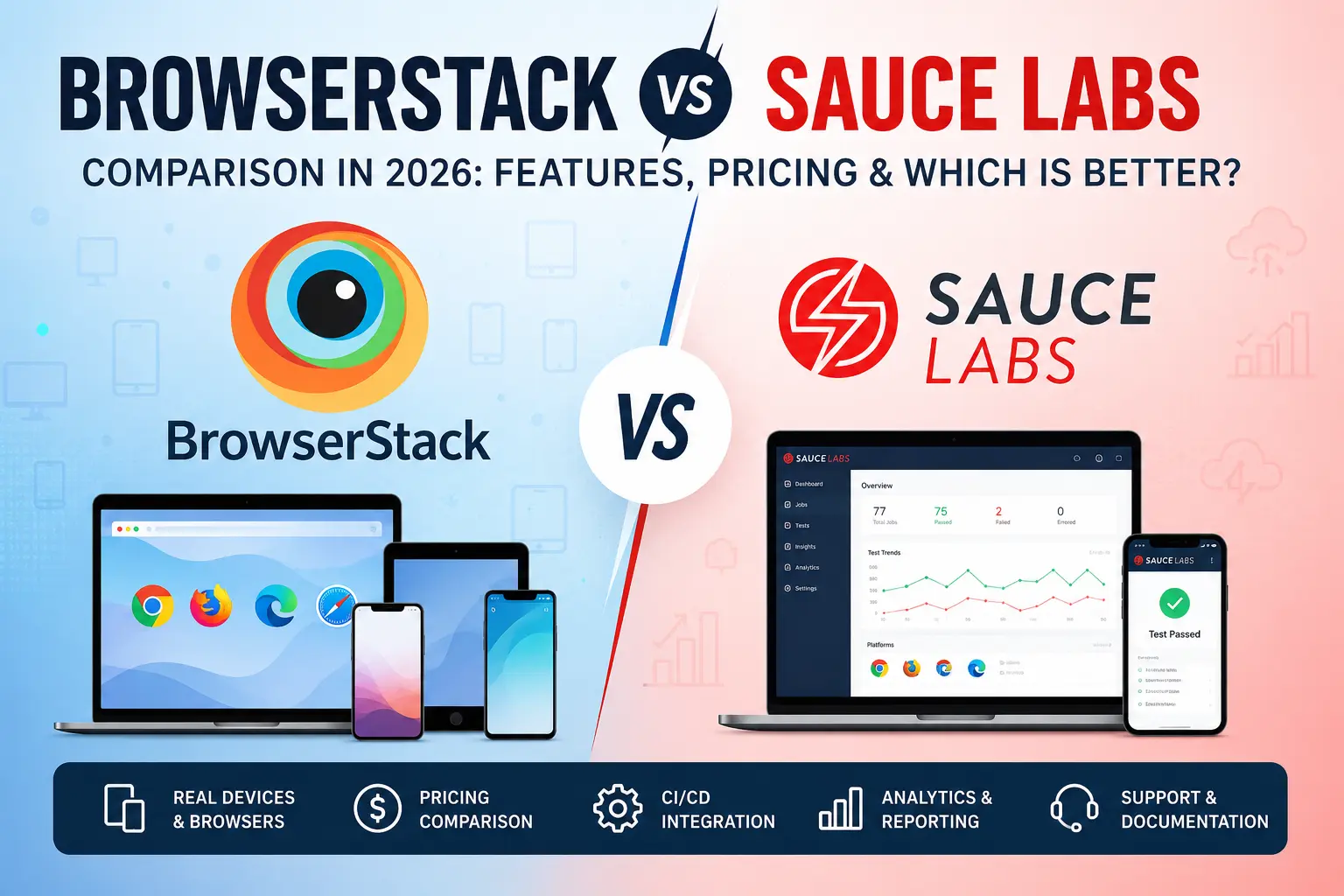
If you are comparing BrowserStack vs Sauce Labs in 2026, you are evaluating two of the most established cloud testing platforms in the industry. Both tools let you run automated and manual tests on real browsers and devices without managing your own infrastructure. But they are not the same — and choosing the wrong one can mean paying for features you do not need or missing capabilities your team requires.
In this guide, I will compare BrowserStack vs Sauce Labs directly across features, pricing, speed, device coverage, CI/CD integration, and overall value — so you can make the right choice for your team.
Table of Contents
BrowserStack vs Sauce Labs — Quick Summary
If you are short on time, here is the quick answer. BrowserStack is the better choice for most teams in 2026 — it has a larger real device cloud, better documentation, and a smoother onboarding experience. Sauce Labs is a strong alternative for enterprise teams that need advanced analytics, extended test history, and deep Salesforce integration.
What Is BrowserStack?
BrowserStack is a cloud-based testing platform founded in 2011 that gives QA engineers and SDETs access to real browsers and devices for both manual and automated testing. It supports Selenium, Playwright, Cypress, Appium, and most major automation frameworks.
BrowserStack runs tests on real devices — not emulators or simulators. This means test results accurately reflect real user experience across thousands of browser and device combinations.
BrowserStack is used by companies including Microsoft, Twitter, Expedia, and Novo Nordisk. It is one of the most widely referenced tools in SDET job descriptions in 2026.
For a full list of tools SDETs use alongside BrowserStack, read my guide to the best AI testing tools for QA engineers.
What Is Sauce Labs?
Sauce Labs is a cloud-based continuous testing platform founded in 2008. Like BrowserStack, it provides access to browsers and devices for automated and manual testing. Sauce Labs supports Selenium, Appium, Cypress, Playwright, and Espresso.
Sauce Labs has a strong focus on enterprise features — advanced analytics, error reporting, extended test history, and compliance certifications. It is particularly well known in the Salesforce testing community due to its deep integration with Salesforce environments.
Sauce Labs was acquired by Symphony Technology Group in 2017 and has continued to develop its enterprise capabilities since then.
BrowserStack vs Sauce Labs — Direct Comparison
| Factor | BrowserStack | Sauce Labs |
|---|---|---|
| Founded | 2011 | 2008 |
| Real devices | 3,500+ | 800+ |
| Browser versions | 3,000+ | 2,000+ |
| Selenium support | ✅ Yes | ✅ Yes |
| Playwright support | ✅ Yes | ✅ Yes |
| Cypress support | ✅ Yes | ✅ Yes |
| Appium support | ✅ Yes | ✅ Yes |
| CI/CD integration | ✅ Yes | ✅ Yes |
| Free tier | ✅ Trial | ✅ Trial |
| Pricing transparency | ✅ Public | ⚠️ Partial |
| Best for | All team sizes | Enterprise teams |
Key Differences Explained
1. Real Device Coverage
This is where BrowserStack has a clear advantage over Sauce Labs.
BrowserStack provides access to over 3,500 real devices, including the latest iPhone, Android, and tablet models. Sauce Labs offers around 800 real devices. For teams that need comprehensive mobile testing coverage across a wide range of devices, BrowserStack wins this category decisively.
Real device testing matters because emulators do not accurately replicate the behavior of real hardware. Browser rendering differences, touch interactions, and performance characteristics all vary between real devices and emulators. If mobile testing is a priority for your team, BrowserStack’s device coverage is a significant advantage.
2. Pricing
BrowserStack publishes its pricing publicly on its website. Plans start from $29 per month for the Live Desktop plan and scale up based on parallel tests, team size, and features required.
Sauce Lab’s pricing is less transparent. Basic pricing information is available, but detailed enterprise pricing requires contacting their sales team. For small teams evaluating options independently, BrowserStack’s transparent pricing makes the decision process easier.
Both platforms offer free trials. BrowserStack offers a free trial with access to all features. Sauce Labs offers a free tier with limited monthly minutes.
You can check the current BrowserStack pricing at browserstack.com/pricing.
3. CI/CD Integration
Both BrowserStack and Sauce Labs integrate with all major CI/CD platforms, including GitHub Actions, Jenkins, CircleCI, and Azure DevOps. Integration quality is comparable between the two platforms.
BrowserStack offers a dedicated CI/CD integration called BrowserStack Automate, which includes test observability features — showing you which tests are flaky, which are consistently failing, and which have never been run. This level of insight is valuable for teams managing large test suites.
Sauce Labs offers similar CI/CD capabilities with its Sauce Insights feature, which provides test analytics and trend reporting across pipeline runs.
4. Test Analytics and Reporting
This is an area where Sauce Labs has historically had an advantage. Sauce Labs offers detailed test analytics, including error classification, test trend analysis, and extended test history going back further than BrowserStack’s default retention.
BrowserStack has significantly improved its analytics capabilities in recent years with the addition of Test Observability — a feature that automatically classifies test failures into categories like product bugs, automation bugs, and environment issues. For teams that struggle to understand why tests are failing, this feature is genuinely useful.
5. Documentation and Support
BrowserStack has some of the best documentation in the testing tools industry. Their guides cover integration with every major framework, language, and CI/CD platform with clear, practical examples. For teams onboarding new members or integrating a new framework, BrowserStack’s documentation saves significant time.
Sauce Labs documentation is comprehensive but less beginner-friendly. It assumes a higher level of existing knowledge, which can make initial setup more challenging for teams new to cloud testing.
BrowserStack also has a reputation for responsive customer support across all plan tiers. Sauce Lab’s support quality is generally strong, but more focused on enterprise accounts.
6. Salesforce Testing
If your team tests Salesforce applications, Sauce Labs has a clear advantage. Sauce Labs has deep Salesforce integration and is one of the few testing platforms with dedicated Salesforce testing capabilities, including support for Salesforce-specific testing frameworks.
BrowserStack supports Salesforce testing, but does not have the same depth of Salesforce-specific features. For teams whose primary application is Salesforce, Sauce Labs is worth serious consideration.
BrowserStack vs Sauce Labs — Pricing Comparison
| Plan Type | BrowserStack | Sauce Labs |
|---|---|---|
| Entry level | $29/month | Free tier available |
| Automate solo | $39/month | Contact for pricing |
| Team plans | Custom pricing | Custom pricing |
| Enterprise | Custom pricing | Custom pricing |
| Free trial | ✅ Yes | ✅ Yes |
Both platforms scale pricing based on the number of parallel tests, team members, and features required. For accurate current pricing, always check the official websites directly.
Who Should Choose BrowserStack?
BrowserStack is the right choice if:
- You need comprehensive real device coverage for mobile testing
- You are a small to mid-size team that wants transparent pricing
- You are new to cloud testing and need excellent documentation
- You use Selenium, Playwright, or Cypress for web automation
- You want to test observability features built into your CI/CD pipeline
- You are an individual SDET building skills for job applications
BrowserStack is the tool mentioned most frequently in SDET job descriptions in 2026. Learning BrowserStack directly improves your employability. Read my guide on how to become an SDET in 2026 for the full list of tools that employers expect.
Who Should Choose Sauce Labs?
Sauce Labs is the right choice if:
- Your team primarily tests Salesforce applications
- You need an extended test history and advanced analytics
- You are a large enterprise with complex compliance requirements
- You need dedicated account management and enterprise support
- Your team already has existing Sauce Labs infrastructure and training
Can You Use Both BrowserStack and Sauce Labs?
Yes — some large teams use both platforms for different purposes. They might use BrowserStack for their main web and mobile test suite due to the device coverage, while using Sauce Labs specifically for Salesforce testing or for teams that prefer its analytics interface.
For most teams, however, choosing one platform and standardizing on it is the more practical approach. Maintaining integrations with two cloud testing platforms adds overhead and cost without proportional benefit for most use cases.
My Recommendation
For most SDETs and QA teams in 2026 — choose BrowserStack.
The larger real device cloud, better documentation, transparent pricing, and strong CI/CD integration make it a more practical choice for the majority of teams. The BrowserStack vs Sauce Labs decision only becomes genuinely competitive if your team has specific Salesforce requirements or needs the extended analytics that Sauce Labs provides at the enterprise level.
If you are an individual SDET building skills — start with BrowserStack. It is more commonly referenced in job descriptions, has better learning resources, and offers a free trial that gives you meaningful hands-on experience.
For a complete picture of the AI testing tools landscape, read my full comparison of the best AI testing tools for QA engineers.
Final Thoughts
The BrowserStack vs Sauce Labs comparison comes down to your team size, testing requirements, and budget. BrowserStack wins on device coverage, documentation, and ease of use. Sauce Labs wins on enterprise analytics and Salesforce integration.
For most teams reading this guide, BrowserStack is the right starting point. Start your free trial, integrate it with your existing CI/CD pipeline, and evaluate whether the device coverage and features meet your needs before committing to a paid plan.
Frequently Asked Questions
Is BrowserStack better than Sauce Labs in 2026?
For most teams, yes. BrowserStack has a larger real device cloud, better documentation, and more transparent pricing. Sauce Labs is better for enterprise teams with Salesforce testing requirements or advanced analytics needs.
Does BrowserStack offer a free trial?
Yes — BrowserStack offers a free trial with access to all features. No credit card is required to start. You can sign up at browserstack.com.
Can I use BrowserStack with Selenium?
Yes — BrowserStack fully supports Selenium 4 and all previous versions. You connect to BrowserStack by changing your WebDriver configuration to point to the BrowserStack remote URL instead of a local driver.
Is Sauce Labs still relevant in 2026?
Yes — particularly for enterprise teams and Salesforce testing. Sauce Labs has a strong customer base and continues to develop its platform actively.
Which is cheaper — BrowserStack or Sauce Labs?
BrowserStack is more transparent about pricing, with plans starting from $29 per month. Sauce Labs pricing for paid plans requires contacting sales, making direct comparison difficult without speaking to both vendors.