
If you are looking for the best API testing tools in 2026, this guide covers everything you need. API testing has become one of the most critical skills for QA engineers and SDETs — and choosing the right tool can dramatically improve your testing efficiency and career prospects.
In this guide, I will review the best API testing tools available in 2026, covering manual testing tools, automation frameworks, performance testing tools, and which combination makes the most sense for your situation.
Table of Contents
Why API Testing Matters in 2026
API testing is no longer optional for QA engineers. Modern applications are built on APIs — the backend services that power everything from mobile apps to web dashboards. Testing at the API layer catches bugs faster, runs more reliably, and provides better coverage than UI testing alone.
For SDETs in particular, API testing knowledge is a non-negotiable requirement. Every SDET job description in 2026 mentions API testing experience. If you are building your automation skills, read my complete guide on how to become an SDET in 2026 for the full roadmap, including API testing.
What Makes a Good API Testing Tool?
Before diving into the best API testing tools, here is the criteria I used for this evaluation.
A good API testing tool must support all major HTTP methods — GET, POST, PUT, DELETE, and PATCH. It must provide clear request and response visibility. It must support environment variables for managing different test configurations. It must integrate with CI/CD pipelines for automated execution. And it must have enough community support that getting help is easy.
Best API Testing Tools in 2026
1. Postman — Best Overall API Testing Tool
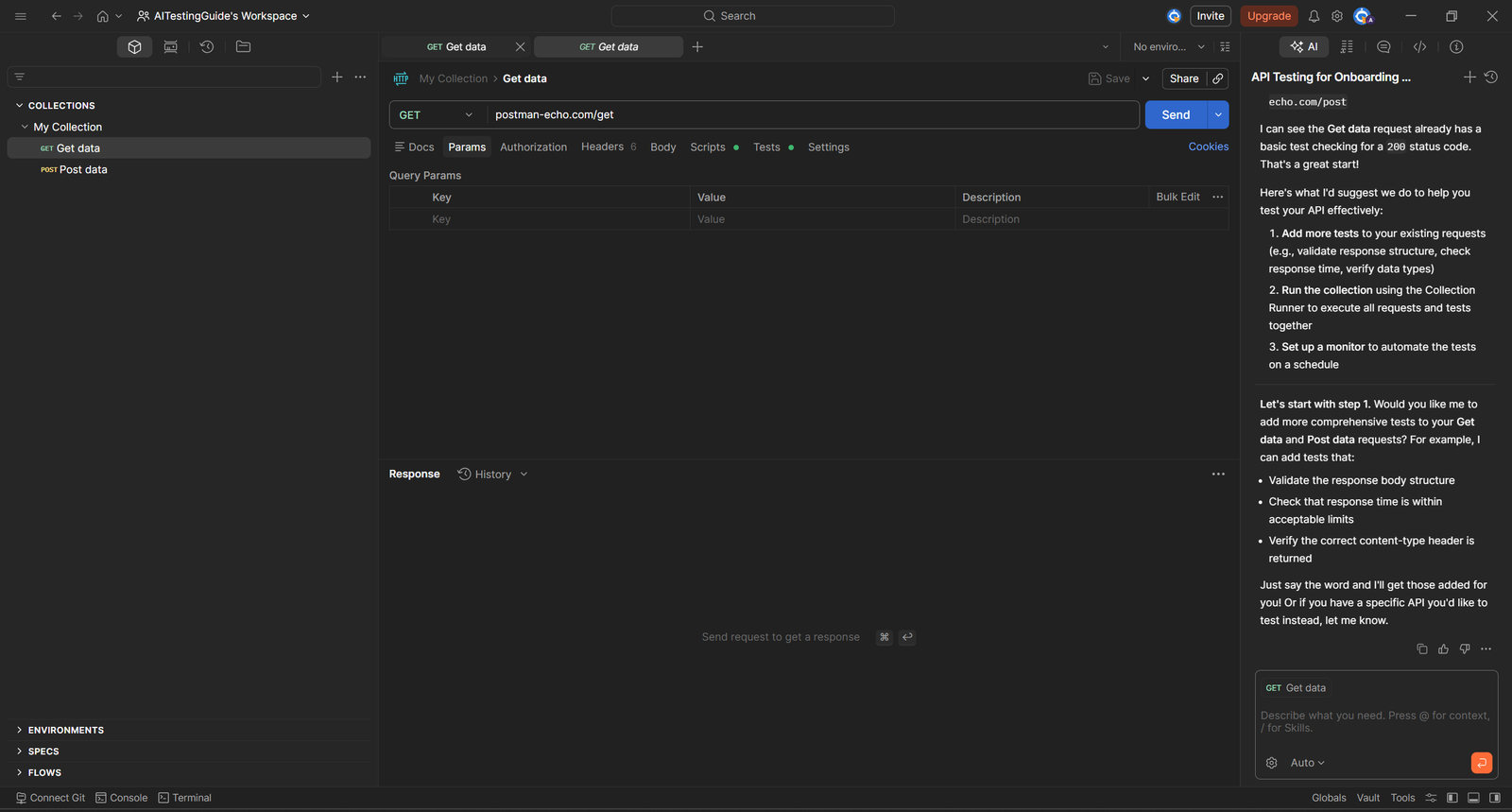
Postman is the best API testing tool for most QA engineers and SDETs in 2026. It is the industry standard for manual API testing and has grown into a comprehensive API platform with automation capabilities.
What Postman offers:
- Visual interface for sending API requests
- Collections for organizing related API tests
- Automated test scripts using JavaScript
- Environment variables for managing test data
- Postbot AI — generates test assertions automatically
- Mock servers for testing without a backend
- API documentation generation
- Team collaboration features
Free tier: Permanent free tier with unlimited API requests, collections, and basic collaboration for up to 3 users.
Paid plans: Solo plan from $9 per month, billed annually. Team plan from $19 per user per month, billed annually.
Who it is for: Every QA engineer and SDET, regardless of experience level. Postman is the first API testing tool you should learn.
My verdict: Postman is the essential starting point for API testing. The free tier is powerful enough for professional use, and the Postbot AI feature makes test creation significantly faster.
You can download Postman for free at postman.com
2. RestAssured — Best for Java Automation
RestAssured is an open source Java library specifically designed for testing REST APIs. It is the most widely used API automation library in Java-based SDET environments and appears frequently in enterprise SDET job descriptions.
What RestAssured offers:
- Fluent, readable API for writing HTTP requests
- Built-in JSON and XML response validation
- Integration with TestNG and JUnit test frameworks
- Support for authentication — Basic, OAuth, API key
- Request and response logging for debugging
- Integration with all major CI/CD platforms
Cost: Completely free and open source.
Who it is for: SDETs working in Java environments or targeting enterprise companies that use Java. If you are learning Java for automation, RestAssured is the API testing library to learn alongside it.
3. Python Requests Library — Best for Python Automation
The Python Requests library is the standard HTTP library for Python and the most widely used tool for API test automation in Python-based frameworks. Combined with Pytest, it provides a powerful, flexible API testing solution at zero cost.
What Python Requests offers:
- Simple, readable API for HTTP requests
- Support for all HTTP methods
- Session management for authenticated requests
- JSON response handling is built in
- Integration with Pytest for test organization
- Works seamlessly with Selenium for combined UI and API tests
Cost: Completely free and open source.
Who it is for: SDETs using Python for automation. If you are following the SDET roadmap on this site — Python plus Requests is your API testing stack.
4. k6 — Best for Performance and Load Testing
k6 is an open source performance testing tool that has become the modern standard for load testing APIs. It uses JavaScript for test scripting and integrates cleanly with CI/CD pipelines.
What k6 offers:
- JavaScript-based test scripting
- HTTP, WebSocket, and gRPC performance testing
- Detailed performance metrics — response time, throughput, error rate
- Threshold configuration for pass/fail criteria
- CI/CD integration with GitHub Actions and Jenkins
- Grafana dashboard integration for visualization
Cost: Completely free for local execution. Grafana Cloud paid plans are available for cloud execution and advanced dashboards.
Who it is for: SDETs who want to add performance testing to their skill set. k6 is the easiest performance testing tool to learn in 2026 and is increasingly expected in senior SDET roles.
5. Insomnia — Best Free Postman Alternative
Insomnia is an open source API testing tool that offers a clean, developer-friendly interface for manual API testing. It is a strong alternative to Postman for teams that prefer open source tools or want to avoid Postman’s cloud dependency.
What Insomnia offers:
- Clean visual interface for API requests
- Support for REST, GraphQL, and gRPC
- Environment variables and request chaining
- Plugin ecosystem for extending functionality
- Local storage — no cloud dependency required
- Git sync for version controlling API collections
Cost: Free open source version available. Paid plans from $12 per month for team features.
Who it is for: Developers and QA engineers who want a Postman alternative with local storage and open source transparency.
You can download Insomnia at insomnia.rest
6. SoapUI — Best for SOAP and Enterprise API Testing
SoapUI is the industry standard tool for testing SOAP web services and complex enterprise APIs. While REST APIs have become dominant, many enterprise systems — particularly in banking, insurance, and government — still use SOAP services.
What SoapUI offers:
- Comprehensive SOAP and REST API testing
- Data-driven testing with external data sources
- Security testing capabilities
- Load testing with SoapUI Pro
- Integration with CI/CD pipelines
Cost: Free open source version available. SoapUI Pro from $659 per year for advanced features.
Pricing is subject to change — always check the official website for current rates.
Who it is for: QA engineers working in enterprise environments with legacy SOAP services. Not necessary for most modern API testing scenarios.
Best API Testing Tools — Quick Comparison
| Tool | Type | Cost | Language | Best For |
|---|---|---|---|---|
| Postman | Manual + Auto | Free tier | JavaScript | All levels |
| RestAssured | Automation | Free | Java | Java SDETs |
| Python Requests | Automation | Free | Python | Python SDETs |
| k6 | Performance | Free | JavaScript | Load testing |
| Insomnia | Manual | Free | Any | Postman alternative |
| SoapUI | Manual + Auto | Free/Paid | Any | Enterprise SOAP |
Best API Testing Tools Stack for SDETs
You do not need all six tools. Here is the recommended stack based on your experience level:
Beginner SDET: Postman for manual testing → Python Requests for automation → GitHub Actions for CI/CD
Intermediate SDET: Add k6 for performance testing → Add RestAssured if working in a Java environment
Senior SDET: Full stack, including Postman, Python Requests, k6, and cloud execution platform
How API Testing Fits Into Your SDET Career
API testing knowledge directly impacts your salary and employability. SDETs who can test both UI and API layers are significantly more valuable than those who only know UI automation.
In SDET interviews, you will be asked about REST API concepts, HTTP methods, status codes, and how to automate API tests. Read my SDET interview questions guide for the exact API testing questions interviewers ask and how to answer them.
For a full list of free tools that complement your API testing stack, read my guide to free AI testing tools that actually work.
Recommended Udemy Course
If you want structured API testing training, this highly rated Postman: The Complete Guide – REST API Testing course on Udemy — covers everything from manual API testing with Postman to automated API testing with Newman and CI/CD integration. Highly recommended for QA engineers at all levels.
Final Thoughts
The best API testing tools in 2026 are Postman for manual testing and Python Requests or RestAssured for automation — depending on your language preference. Add k6 for performance testing when you are ready to expand your skill set.
Start with Postman. Learn it thoroughly. Then add Python Requests automation. This combination covers everything most SDET roles require and costs nothing.
Frequently Asked Questions
What is the best API testing tool for beginners in 2026?
Postman is the best starting point for API testing beginners. It has a visual interface that makes it easy to understand HTTP requests and responses without writing code. The free tier is powerful enough for professional use, and the Postbot AI feature accelerates test creation.
Is Postman free to use?
Yes — Postman offers a permanently free tier with unlimited API requests, collections, and basic collaboration for up to 3 users. Paid plans start from $14 per user per month for advanced team features.
What is the difference between Postman and RestAssured?
Postman is a visual tool used for both manual and automated API testing. RestAssured is a Java library used specifically for automated API testing within a code-based framework. Most SDETs use Postman for exploration and RestAssured or Python Requests for automation.
Do I need to know coding for API testing?
For manual API testing with Postman — no, minimal coding is required. For automated API testing with Python Requests or RestAssured — yes, programming skills are required. Most SDET roles expect automated API testing capability.
What is k6 used for?
k6 is a performance and load testing tool used to verify that APIs perform correctly under high traffic conditions. It simulates multiple concurrent users sending requests to your API and measures response times, error rates, and throughput.