Comparing JMeter vs k6 in 2026? This guide gives you a clear, honest answer.
Both tools are free and widely used for performance testing — if you are new to testing tools entirely, our best AI testing tools guide gives you the full landscape first. However, they follow very different philosophies and suit different workflows.
I studied both tools in depth. I also analysed real SDET job postings and tested how they fit into modern CI/CD workflows. This is the comparison written from the perspective of an engineer building a career — not just evaluating features.
Table of Contents
JMeter vs k6 — Quick Comparison Table
This JMeter vs k6 comparison table gives you the full picture at a glance before we dive into the details.
| Feature | JMeter | k6 |
|---|---|---|
| Underlying Tech | Java / JVM | Go engine |
| Scripting Language | GUI + XML (.jmx) | JavaScript (ES6) |
| Interface | GUI + CLI | CLI only |
| Primary Use Case | Enterprise / Legacy systems | API testing / CI/CD |
| Resource Usage | High — thread-based | Low — lightweight |
| CI/CD Integration | Possible but complex | Built-in, native |
| Learning Curve | Moderate — GUI helps beginners | Low for JS developers |
| AI-Assisted Scripting | Difficult — complex XML | Excellent — clean JS |
| Cost | Free + BlazeMeter (paid cloud) | Free + Grafana Cloud (paid) |
| Best For | Legacy enterprise teams | Modern SDETs and DevOps |
Pricing is subject to change — always check official websites for current rates.
What Is JMeter and Who Is It For?
JMeter is an Apache open-source performance testing tool that has been the industry standard for over 20 years. It runs on the JVM, uses a GUI-driven workflow for building test plans, and saves everything in .jmx XML files.
The screenshot below shows how JMeter uses a GUI-based approach to configure HTTP requests for performance testing.
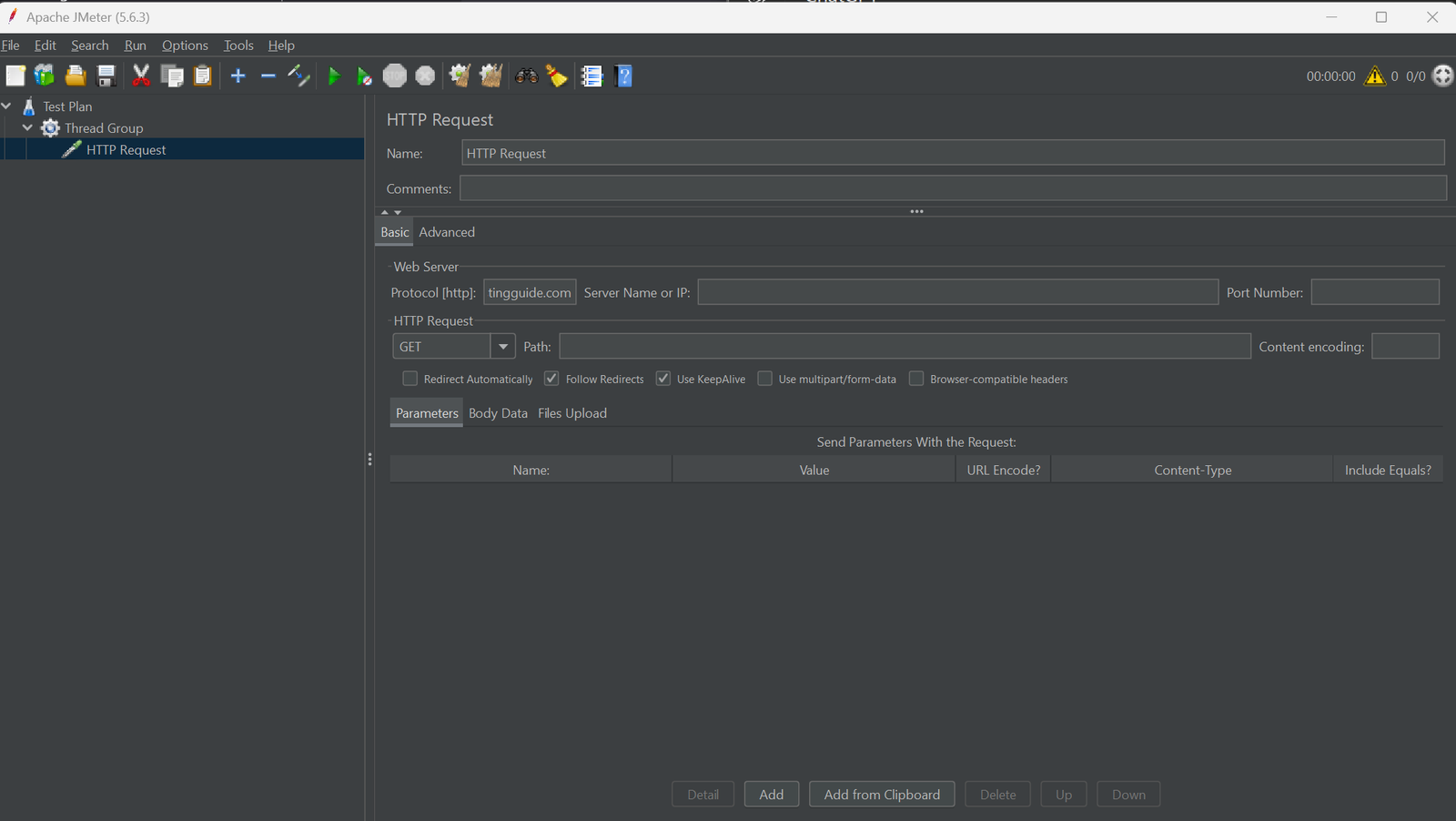
In this example, JMeter is configured to send HTTP requests to a target server. This visual approach makes it easier for beginners to build and manage test plans.
JMeter’s biggest strength is protocol support. Out of the box, it handles HTTP, HTTPS, FTP, JDBC, LDAP, SOAP, and more. For large enterprise teams testing legacy systems with complex protocol requirements, JMeter remains the most complete option available in 2026.
The honest weakness is resource consumption. JMeter runs tests using Java threads, and each thread consumes significant memory. Generating 10,000 virtual users on a single machine is difficult without a distributed testing setup or a cloud platform like BlazeMeter.
JMeter is the right choice for:
- Teams maintaining legacy enterprise systems with complex protocol needs
- Organisations with existing JMeter infrastructure and test suites
- Engineers who prefer a visual GUI for building test plans
- Java-heavy teams already using TestNG or JUnit 5 — if you are on this path, check our Selenium vs Playwright comparison to understand where UI automation fits alongside performance testing.
What is k6 and Who Is It For?
The example below shows how k6 executes a load test and displays real-time performance metrics directly in the command line.
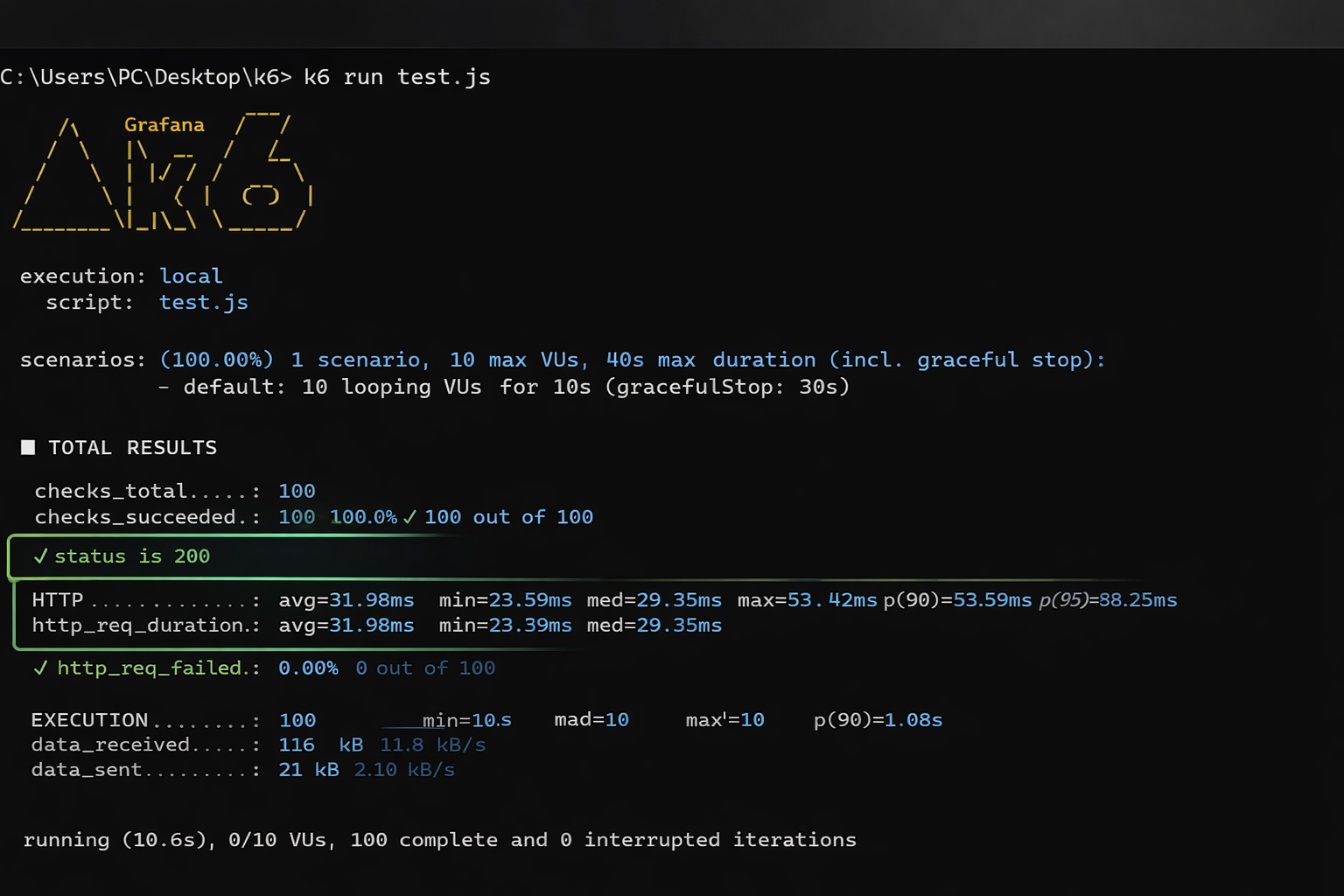
This output includes key metrics such as response time, virtual users, and success rate. It demonstrates how k6 provides fast and lightweight performance testing results suitable for CI/CD workflows.
k6 is a modern open-source load testing tool built by Grafana Labs. It runs on Go, making it extremely lightweight.
A single k6 instance can generate tens of thousands of virtual users on standard hardware. JMeter would require a distributed cluster to match this.
The fundamental difference is philosophy. k6 is pure Infrastructure as Code. Every test is written in JavaScript and stored in your Git repository. It runs from the CLI and integrates into CI/CD pipelines with a single command. There is no GUI, no XML, no drag and drop — just clean code.
k6 is the right choice for:
- SDETs building modern automation portfolios for job applications — read our SDET resume guide to see exactly how to present these skills to hiring managers.
- Teams running API performance tests inside CI/CD pipelines
- Engineers comfortable with JavaScript or willing to learn it
- DevOps and QAOps workflows requiring automated performance gates
JMeter vs k6 — The 7 Key Differences That Actually Matter
1. JMeter vs k6 Scripting Approach — GUI vs Code
This is the fundamental divide between the two tools.
JMeter uses a graphical test plan builder where you drag and drop samplers, listeners, and thread groups. The result is saved as a .jmx XML file — a heavily nested document that becomes difficult to read, review in Git, or maintain at scale.
k6 uses JavaScript. Your entire load test is a clean .js file that looks like this:
import http from 'k6/http';
import { check, sleep } from 'k6';

export const options = {
  vus: 100,
  duration: '30s',
  thresholds: {
    http_req_duration: ['p95<200'],
  },
};

export default function () {
  const res = http.get('https://test-api.example.com/users');
  check(res, { 'status is 200': (r) => r.status === 200 });
  sleep(1);
}
That k6 script runs 100 virtual users for 30 seconds. It automatically fails if 95% of requests are not under 200ms. The same JMeter test requires 15 to 20 GUI steps. It also produces a large XML file with hundreds of lines.
Verdict for SDETs: k6 wins decisively. The code-first approach fits directly into modern automation workflows and is dramatically easier to maintain.
2. CI/CD Integration — Where k6 Wins Completely
These tools differ significantly in CI/CD pipeline integration.
Running k6 in GitHub Actions takes one step:
- name: Run k6 load test
  uses: grafana/k6-action@v0.3.0
  with:
    filename: tests/load-test.js
k6 runs, applies your thresholds, and fails the pipeline automatically if performance degrades — this is the same CI/CD-first mindset covered in our best API testing tools guide. No additional configuration required.
JMeter CI/CD integration requires installing Java and configuring CLI mode. You also need result parsing and manual pass/fail criteria using plugins. It works — but it takes significantly more engineering effort to maintain.
Verdict for SDETs: k6 is the native CI/CD tool. If you are building a modern SDET portfolio with GitHub Actions integration, k6 is the clear choice.
3. Resource Efficiency — The Real Numbers in 2026
Every article online quotes outdated 2021 benchmarks claiming k6 is “10x more memory efficient.” The reality in 2026 is more nuanced.
Recent JVM optimisations have narrowed the resource gap. JMeter with modern JVM tuning performs better than older benchmarks suggest. However, k6 still requires significantly less memory per virtual user due to its Go-based goroutine model versus JMeter’s Java thread model.
In practical terms — k6 handles 5,000 virtual users comfortably on a single machine. JMeter at that scale requires a distributed testing setup or a paid cloud solution.
Verdict for SDETs: k6 remains more resource-efficient for high-concurrency testing on single machines.
4. Protocol Support — The xk6 Factor Nobody Mentions
The biggest myth in JMeter vs k6 comparisons is that k6 lacks JMeter’s protocol support. In 2026, this is no longer true.
The xk6 extension framework allows k6 to support WebSocket, gRPC, SQL, Kafka, and dozens of other protocols through community-built extensions. The claim that k6 is “HTTP only” is outdated by at least two years.
JMeter still has broader built-in protocol support without requiring extensions. If you are testing LDAP, FTP, or JDBC out of the box, JMeter is simpler to configure. But for the vast majority of modern API testing scenarios, k6 with xk6 extensions covers everything you need.
Verdict for SDETs: JMeter wins for legacy protocol diversity. k6 covers modern API testing comprehensively.
5. AI-Assisted Script Generation — The Angle Nobody Covers
This aspect is often overlooked in competitor articles.
If you use ChatGPT, Claude, or Gemini to write your performance tests, k6 wins by a massive margin.
Ask an AI to generate a k6 JavaScript test, and you get clean, readable, immediately runnable code in seconds. Ask it to generate a JMeter .jmx XML file, and the result is a complex nested document that is difficult to validate and hard to debug without opening the GUI.
k6’s Infrastructure as Code approach makes it ideal for AI-assisted test generation. This aligns with the direction of modern SDET workflows.
Verdict for SDETs: k6 is dramatically better for AI-assisted scripting workflows.
6. Learning Curve for Career Changers
For a QA engineer transitioning to SDET, the learning curve question matters.
JMeter’s GUI makes it easy to start. You can create a basic HTTP test plan without writing any code.
However, advanced use is more complex. You need to learn JMeter’s DSL, scripting functions, and plugins for dynamic data and CI/CD integration.
k6 requires JavaScript knowledge upfront. If you already know JavaScript from Cypress or Playwright automation, k6 has almost no additional learning curve. If you are coming from Python or Java, there is a short adjustment period — but JavaScript is a more transferable skill than JMeter’s proprietary scripting system.
Verdict for SDETs: JMeter is easier on day one. k6 is more valuable at month six and beyond.
7. Career Value in 2026 — What Job Postings Actually Show
SDET job postings in 2026 show a clear trend. JMeter still appears frequently in enterprise and banking sector roles. k6 appears in modern tech companies, startups, and any organisation running DevOps or QAOps practices.
For GitHub portfolios, k6 is the stronger choice. A clean k6 test suite with GitHub Actions integration signals exactly the skills modern SDET employers want — code-driven testing, CI/CD integration, and performance awareness.
Verdict for SDETs: Learn both, but prioritise k6 for your portfolio.
The JMeter vs k6 Migration Reality
One topic completely missing from competitor articles is the actual engineering effort required to migrate from JMeter to k6.
Converting .jmx test plans to k6 JavaScript is not straightforward. The structures are fundamentally different. JMeter components do not map cleanly to k6’s executor and metric system.
Grafana provides a jmeter-to-k6 conversion tool, but it produces verbose JavaScript that requires significant cleanup. Realistically, migration is a rewrite project — not a conversion project.
If your team has years of JMeter test suites, migration cost is a genuine consideration. For new projects starting in 2026 with no legacy constraints, there is no reason to choose JMeter over k6.
Which Tool Should You Learn First as an SDET?
Understanding the JMeter vs k6 difference clearly is the first step to making the right career decision.
If you are building your SDET portfolio from scratch in 2026 — learn k6 first.
k6 integrates directly into the CI/CD pipelines you are already building with GitHub Actions. The JavaScript syntax is clean and AI-friendly. The code lives in your Git repository alongside your Selenium and Playwright tests. And k6 skills are increasingly in demand at modern tech companies.
Add JMeter to your skills after k6 if:
- You are targeting enterprise, banking, or government sector SDET roles
- A job posting you want specifically lists JMeter as a requirement
- You are joining a team with an existing JMeter infrastructure
To build the programming foundation needed for both tools, the Selenium Python Automation course on Udemy is rated 4.6 stars and gives you the core scripting mindset that transfers directly to k6 JavaScript test writing.
Final Thoughts
The JMeter vs k6 comparison in 2026 is not about which tool is better. It is about which one fits your career and workflow.
JMeter is a battle-tested enterprise tool with 20 years of community support. For legacy systems and broad protocol coverage, nothing replaces it. k6 is the modern SDET’s performance testing tool — code-driven, CI/CD native, AI-friendly, and built for the workflows that dominate the industry today.
For your portfolio, learn k6 first. For your job applications, know JMeter and understand when teams use it. Combining both tools makes you a more complete and employable SDET.
If you are building your SDET foundation, read our complete guide on how to become an SDET in 2026. For more tool comparisons, check our best API testing tools guide and our Selenium vs Playwright comparison.
Frequently Asked Questions
What is the difference between JMeter and k6 for performance testing?
JMeter is a Java-based GUI tool that uses XML test plans and supports a broad range of protocols. k6 is a Go-based CLI tool where tests are written in JavaScript, making it lightweight, CI/CD native, and far easier to version control in modern DevOps workflows.
Which tool is better for beginners: JMeter or k6?
JMeter is easier on day one because the GUI removes the need to write code immediately. k6 requires JavaScript knowledge upfront but becomes more intuitive faster for engineers already comfortable with code-based automation frameworks.
Is k6 faster and more efficient than JMeter?
Yes, in most scenarios. k6’s Go-based architecture uses goroutines instead of Java threads, consuming significantly less memory per virtual user. A single k6 instance handles tens of thousands of virtual users, where JMeter would require a distributed setup.
Can JMeter and k6 both integrate with CI/CD pipelines?
Yes, but with very different levels of effort. k6 has native GitHub Actions support and integrates in minutes. JMeter requires additional configuration, plugin setup, and result parsing to achieve the same outcome.
Which is easier to learn for SDETs: JMeter or k6?
For SDETs already familiar with JavaScript, k6 has a shorter overall learning curve. For SDETs from purely manual testing backgrounds, JMeter’s GUI provides a gentler entry point.
Is JMeter still relevant in 2026 compared to k6?
Yes. JMeter remains dominant in the enterprise, banking, and government sectors with significant legacy infrastructure. It appears in a large percentage of SDET job postings. The tools are complementary rather than competitive.
What are the main use cases of JMeter vs k6 in real projects?
JMeter excels at enterprise regression performance testing and legacy protocol testing. k6 excels at API load testing, CI/CD pipeline performance gates, and modern cloud-native application testing.
How does pricing compare between JMeter and k6?
Both tools are free and open source for local execution. For cloud-based distributed testing, JMeter scales through BlazeMeter and k6 through Grafana Cloud. Check official websites for current pricing.