LLM evaluation metrics are the scoring systems SDETs use to measure whether an AI model’s output is accurate, relevant, and safe — and almost every guide explaining them is written for data scientists, not testers. They define the math behind “faithfulness” in three paragraphs, but never show you how to write the test that asserts it.
This guide flips that. It explains every important LLM evaluation metric from a testing perspective — what each one measures, when to use it, the code to run it, and the pass/fail threshold to set in CI/CD. Think of an LLM evaluation metric as a dynamic test oracle, not a research concept.
What are LLM evaluation metrics?
LLM evaluation metrics are scoring methods that measure the quality, accuracy, and safety of a large language model’s output. They fall into three groups: reference-based metrics like BLEU and ROUGE that compare output to a known answer, reference-free metrics like answer relevancy that judge output on its own merits, and LLM-as-a-judge metrics that use a strong model to score subjective qualities. SDETs set numeric thresholds on these metrics — for example faithfulness above 0.8 — to pass or fail builds automatically in CI/CD.
Table of Contents
Why LLM Evaluation Metrics Replace Traditional Assertions
LLM evaluation metrics exist because traditional pass/fail assertions break on AI output. When you test a login form, the result is deterministic — the URL either contains “dashboard” or it does not. LLM output is probabilistic, so the same prompt produces different valid wording each time.
This is the core shift every SDET must understand. You cannot assert output == "expected string" on an LLM. Instead, you score the output against a metric and assert the score crosses a threshold.
- Traditional assertion:
assert response == "Order #123 shipped" - LLM metric assertion:
assert answer_relevancy_score >= 0.8
An LLM evaluation metric is essentially a dynamic test oracle — it decides whether output is correct when there is no single correct string. For the broader testing context, see our guide on how to test LLM applications.
The Three Categories of LLM Evaluation Metrics
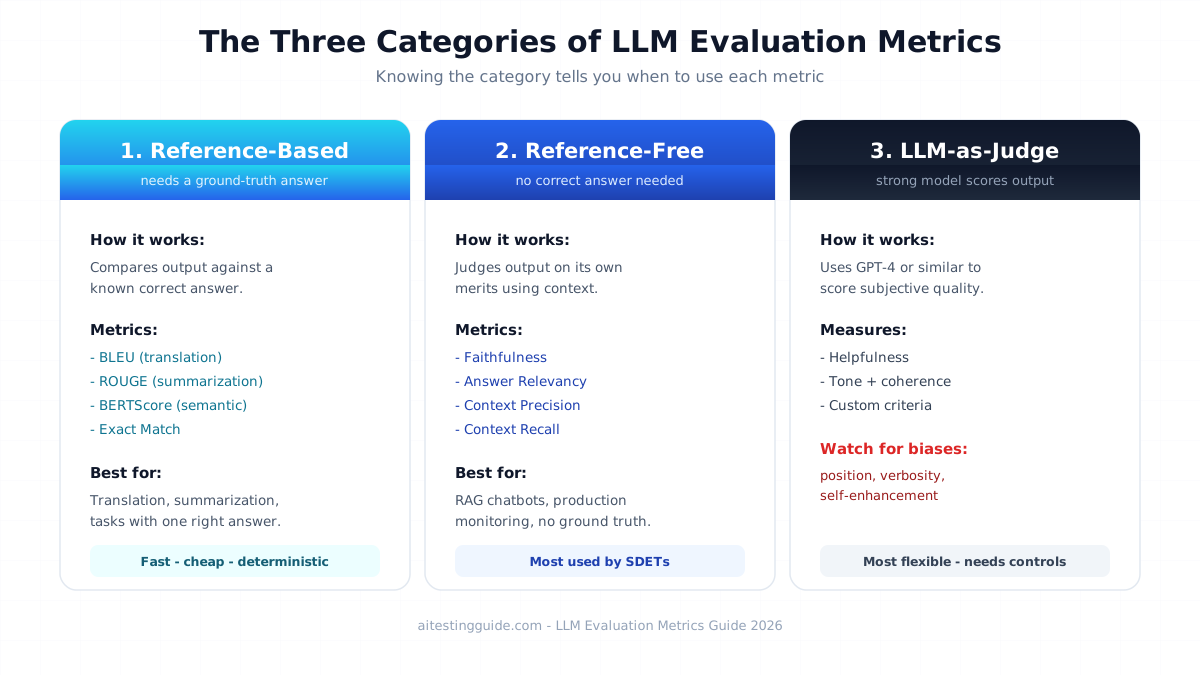
Every LLM evaluation metric falls into one of three categories based on how it scores output. Knowing the category tells you when to use the metric and what it can and cannot catch.
1. Reference-Based Metrics
Reference-based metrics compare the model’s output against a known ground-truth answer. They need a “correct” answer to measure against. These are fast, cheap, and deterministic — but only work when you have a gold-standard dataset.
2. Reference-Free Metrics
Reference-free metrics evaluate output on its own merits without needing a correct answer. Answer relevancy and faithfulness are reference-free — they judge whether the response addresses the question and stays grounded in context. Essential for production monitoring where no ground truth exists.
3. LLM-as-a-Judge Metrics
LLM-as-a-judge metrics use a strong model like GPT-4 to score subjective qualities such as helpfulness, tone, and coherence. This is the most flexible category, but carries risks — judge models have biases that SDETs must account for.
RAG Evaluation Metrics Every SDET Should Know
RAG evaluation metrics are split into two groups: retrieval quality and generation quality. Because most production LLM applications use Retrieval-Augmented Generation, these are the metrics SDETs use most often.
- Faithfulness — did the model stick only to the retrieved context, or did it hallucinate? Tests the generator
- Answer Relevancy — does the output directly address the user’s question? Tests the generator
- Context Precision — did retrieval fetch the right chunks and rank them well? Tests the retriever
- Context Recall — did retrieval fetch all the information needed? Tests the retriever
The key insight competitors miss: when faithfulness is low, fix the generator or prompt. When context recall is low, fix the retriever or chunking. Component-wise evaluation tells you exactly where the pipeline broke. For the framework that implements these, see our guide on what RAGAS is and our DeepEval review.
How to Implement LLM Evaluation Metrics in Code
To implement LLM evaluation metrics, use a framework like DeepEval that turns each metric into a pytest-style assertion with a threshold. This is the execution layer that vendor articles skip entirely.
Here is a complete test asserting two metrics with thresholds:
from deepeval import assert_test
from deepeval.test_case import LLMTestCase
from deepeval.metrics import AnswerRelevancyMetric, FaithfulnessMetric

def test_support_bot_answer():
    test_case = LLMTestCase(
        input="Can I return a product after 20 days?",
        actual_output="No, our return window is 14 days from delivery.",
        retrieval_context=["Returns accepted within 14 days of delivery."]
    )

    # Reference-free metrics with pass/fail thresholds
    relevancy = AnswerRelevancyMetric(threshold=0.8)
    faithfulness = FaithfulnessMetric(threshold=0.8)

    # Fails the build if either score drops below 0.8
    assert_test(test_case, [relevancy, faithfulness])
This is the bridge competitors never build — turning an abstract metric like “faithfulness” into an executable assertion that fails a CI/CD build. The threshold is your quality gate.
Legacy NLP Metrics — BLEU, ROUGE, and BERTScore
Legacy NLP metrics like BLEU, ROUGE, and BERTScore measure text similarity mathematically and remain useful for specific LLM evaluation tasks. They predate LLM-as-a-judge but are faster and cheaper for reference-based comparison.
- BLEU — measures word overlap between output and reference. Best for translation tasks
- ROUGE — measures overlap for summarization. Checks how much of the reference appears in the output
- BERTScore — uses embeddings to measure semantic similarity, not just exact word matching
- Perplexity — measures how confidently a model predicts text. Lower is more fluent
The honest take: BLEU and ROUGE are weak for modern generative output because they reward word overlap, not correctness. A factually wrong answer using the right words can score high. Use them for translation and summarization, but rely on LLM-as-a-judge metrics for open-ended responses.
The Hidden Risk — LLM-as-a-Judge Biases
LLM-as-a-judge metrics carry biases that SDETs must control, or your evaluation scores will be unreliable. This is the pitfall vendor articles ignore because it undermines their own tools.
- Position Bias — the judge model favors whichever answer it sees first or last. Fix by randomising order across runs
- Verbosity Bias — longer answers get rated higher simply for being longer, not better. Fix by controlling for length
- Self-Enhancement Bias — a judge model rates output from its own model family higher. Fix by using a different model family as judge
An SDET who knows these biases builds more reliable evaluation suites than a data scientist who only knows the metric definitions. This is your competitive edge as a tester.
LLM Evaluation Metrics by Tool — Comparison
The same LLM evaluation metric is implemented differently across frameworks. Here is how the leading open-source tools compare for SDET workflows.
| Framework | Best For | Metric Style | Cost |
|---|---|---|---|
| DeepEval | Pytest-style metric assertions | 14+ built-in metrics | Free + $19/mo |
| RAGAS | RAG retrieval + generation | RAG-specific | Free |
| Promptfoo | Config-driven eval + red teaming | YAML assertions | Free + $50/mo |
| TruLens | Observability + feedback functions | Programmatic | Free |
Pricing is subject to change — always check the official website for current rates.
Which LLM Evaluation Metrics to Use When
Choosing the right LLM evaluation metric depends on what you are testing and whether you have a ground-truth answer. Here is the practical decision guide most articles never give.
- Testing a RAG chatbot? Use faithfulness, answer relevancy, context precision, and context recall
- Testing summarization? Use ROUGE plus a faithfulness check for hallucinations
- Testing translation? Use BLEU plus BERTScore for semantic accuracy
- Production monitoring with no ground truth? Use reference-free metrics only
- Testing tone or helpfulness? Use LLM-as-a-judge with bias controls
For security-specific evaluation, combine these with our prompt injection testing guide and hallucination testing guide.
How to Add LLM Evaluation Metrics to CI/CD
To add LLM evaluation metrics to CI/CD, run your metric assertions as a pipeline stage that fails the build when scores drop below the threshold. This treats AI quality exactly like any other automated test gate.
# .github/workflows/llm-eval.yml
name: LLM Evaluation
on: [push]
jobs:
  evaluate:
    runs-on: ubuntu-latest
    steps:
      - uses: actions/checkout@v4
      - name: Install DeepEval
        run: pip install deepeval
      - name: Run metric assertions
        run: deepeval test run test_llm_metrics.py
        # Build fails if any metric score < threshold
For a complete pipeline setup, see our GitHub Actions for test automation guide.
Real-World Use Case — Evaluating a Documentation Bot
Here is how an SDET used LLM evaluation metrics to catch a quality regression in a developer documentation chatbot before release.
The setup: A RAG bot answering questions from API documentation, with a 60-question golden dataset and four metrics running on every deployment — faithfulness, answer relevancy, context precision, context recall.
What happened: A change to the document chunking strategy looked fine in manual spot checks. But the automated suite caught context recall dropping from 0.91 to 0.62 — the new chunking was splitting key information across boundaries, so retrieval missed it. Faithfulness stayed high (0.89) because the bot did not hallucinate; it just gave incomplete answers.
The lesson: Without component-wise metrics, this regression would have shipped. Faithfulness alone looked healthy. Only context recall exposed the broken retrieval. This is why SDETs measure the retriever and generator separately. See our how to become an SDET guide for building these evaluation skills.
Final Thoughts
LLM evaluation metrics are not a data science specialty — they are the new assertions in your test suite. Every metric is a quality gate: faithfulness catches hallucinations, context recall catches broken retrieval, and answer relevancy catches off-topic responses. The SDETs who treat these as executable thresholds in CI/CD, not abstract research concepts, are the ones who will own AI quality in 2026.
Start with two reference-free metrics — faithfulness and answer relevancy — on a small golden dataset. Set thresholds at 0.8. Add them to your pipeline. Expand into RAG component metrics and bias-controlled LLM-as-a-judge from there. To build the automation foundation that makes this work, this Selenium WebDriver with Python course on Udemy covers the test framework fundamentals you need.
Disclosure: This article contains affiliate links. If you purchase through these links, I earn a small commission at no extra cost to you.
Frequently Asked Questions
What are LLM evaluation metrics in AI testing?
LLM evaluation metrics are scoring methods that measure the quality, accuracy, and safety of a large language model’s output. In AI testing, SDETs use them as assertions — setting numeric thresholds like faithfulness above 0.8 — to automatically pass or fail builds. They replace traditional exact-match assertions, which break on non-deterministic AI output.
Which LLM evaluation metrics are most important for QA engineers?
The most important LLM evaluation metrics for QA engineers are faithfulness (catches hallucinations), answer relevancy (catches off-topic responses), context precision, and context recall (catches broken retrieval in RAG systems). These four reference-free metrics cover most production testing needs and can all be automated with thresholds in CI/CD.
How do you measure LLM accuracy and hallucinations?
You measure LLM hallucinations using the faithfulness metric, which scores whether the output stays grounded in the provided context. Run the model against a golden dataset and assert faithfulness stays above a threshold like 0.8. A low score means the model invented information not present in its source context.
What is the difference between automated and human LLM evaluation?
Automated LLM evaluation uses metrics and LLM-as-a-judge scoring to test at scale in CI/CD with no human in the loop. Human evaluation uses people to judge subjective qualities like tone and empathy. Best practice combines both — automated metrics catch most regressions cheaply, while humans review flagged edge cases that the metrics cannot judge reliably.
How can SDETs test LLM response quality effectively?
SDETs test LLM response quality by building a golden dataset of verified question-answer pairs, then scoring responses with reference-free metrics like faithfulness and answer relevancy. Set thresholds, run on every deployment, and fail builds that drop below them. Use component-wise metrics to separate retriever quality from generator quality in RAG systems.
What metrics are used to evaluate AI chatbot performance?
AI chatbot performance is evaluated with faithfulness, answer relevancy, context precision, and context recall for accuracy, plus operational metrics like latency, token usage, and cost per query. Safety metrics like toxicity and prompt injection resilience round out the suite. See our dedicated guide on how to test AI chatbots for the full workflow.
How do BLEU, ROUGE, and BERTScore compare for LLM evaluation?
BLEU measures word overlap and suits translation. ROUGE measures reference coverage and suits summarization. BERTScore uses embeddings to measure semantic similarity rather than exact words. All three are reference-based and need a ground-truth answer. They are weaker than LLM-as-a-judge metrics for open-ended responses because they reward word overlap, not factual correctness.
What are the best frameworks for LLM evaluation in 2026?
The best LLM evaluation frameworks in 2026 are DeepEval for pytest-style metric assertions, RAGAS for RAG-specific retrieval and generation metrics, Promptfoo for config-driven evaluation and red teaming, and TruLens for observability with feedback functions. All are open-source with free tiers, making them ideal for SDETs building automated evaluation suites.
How do you automate LLM evaluation in CI/CD pipelines?
Automate LLM evaluation by running metric assertions as a CI/CD pipeline stage. Install a framework like DeepEval, define test cases with thresholds, and run them on every push. The build fails if any metric score drops below its threshold — for example, faithfulness below 0.8. This treats AI quality like any other automated test gate.
What challenges do QA teams face when testing LLM-based applications?
QA teams face non-deterministic outputs that break exact-match assertions, the cost and latency of LLM-as-a-judge scoring, judge biases like position and verbosity bias, the need for golden datasets, and separating retriever from generator failures in RAG systems. Overcoming these requires metric-based thresholds, bias controls, and component-wise evaluation rather than traditional testing methods.