
Choosing between Mabl vs Testim is a common challenge in AI test automation. The wrong choice can cost your team months of rework and wasted effort.
I tested both platforms hands-on. This guide covers 7 proven differences that matter for QA engineers and SDETs in 2026. By the end, you will know which tool fits your workflow, budget, and career goals.
Table of Contents
What Is Mabl?
Mabl is a unified, cloud-based AI testing platform designed for modern QA teams. You can explore more on the official Mabl website. It supports both UI and API testing in one interface.
Mabl’s core strength is its auto-healing engine. When the DOM changes, it updates affected test steps automatically.
Mabl is built around a concept called the Mabl Trainer, which records user journeys and generates reusable test flows. In 2025, Mabl introduced an Agentic Tester capability, meaning the platform can explore your app autonomously to discover potential failure points.
Mabl positions itself firmly in the enterprise segment, with custom pricing and a strong focus on CI/CD pipeline integration via GitHub Actions, Jenkins, and GitLab CI.
For a deeper look at Mabl alone, read our full Mabl review.
What Is Testim?
Testim, now owned by Tricentis, is an AI-powered test automation platform built around its signature Smart Locators technology. Testim uses machine learning to identify DOM elements dynamically. This makes tests more stable when the UI changes. You can check its features on the official Testim website.
Testim is known for fast onboarding, an intuitive recorder, and a freemium pricing tier that lets small teams start immediately without a procurement process. For an SQA engineer moving into automation, Testim is often the first AI testing tool they encounter.
Since the Tricentis acquisition, Testim has been positioned more firmly in enterprise sales cycles, but the self-serve free tier remains available as of 2026.
See our full Testim review for a standalone evaluation.
Mabl vs Testim — Pricing Comparison
Pricing is one of the most important factors when evaluating Mabl vs Testim.
Testim Pricing (2026):
- Free tier: Available (limited executions)
- Paid plans: Custom pricing through Tricentis sales
- Free trial: 7 days (not 14 — verified directly from testim.io)
Mabl Pricing (2026):
- No public pricing listed
- All plans require a custom quote from the Mabl sales team
- Free trial: Available on request
Both tools have moved toward enterprise sales motions in 2026. For individual SDETs or small freelance automation contracts, Testim’s free tier gives it a clear practical advantage for getting started without budget approval.
Pricing is subject to change — always check the official website for current rates.
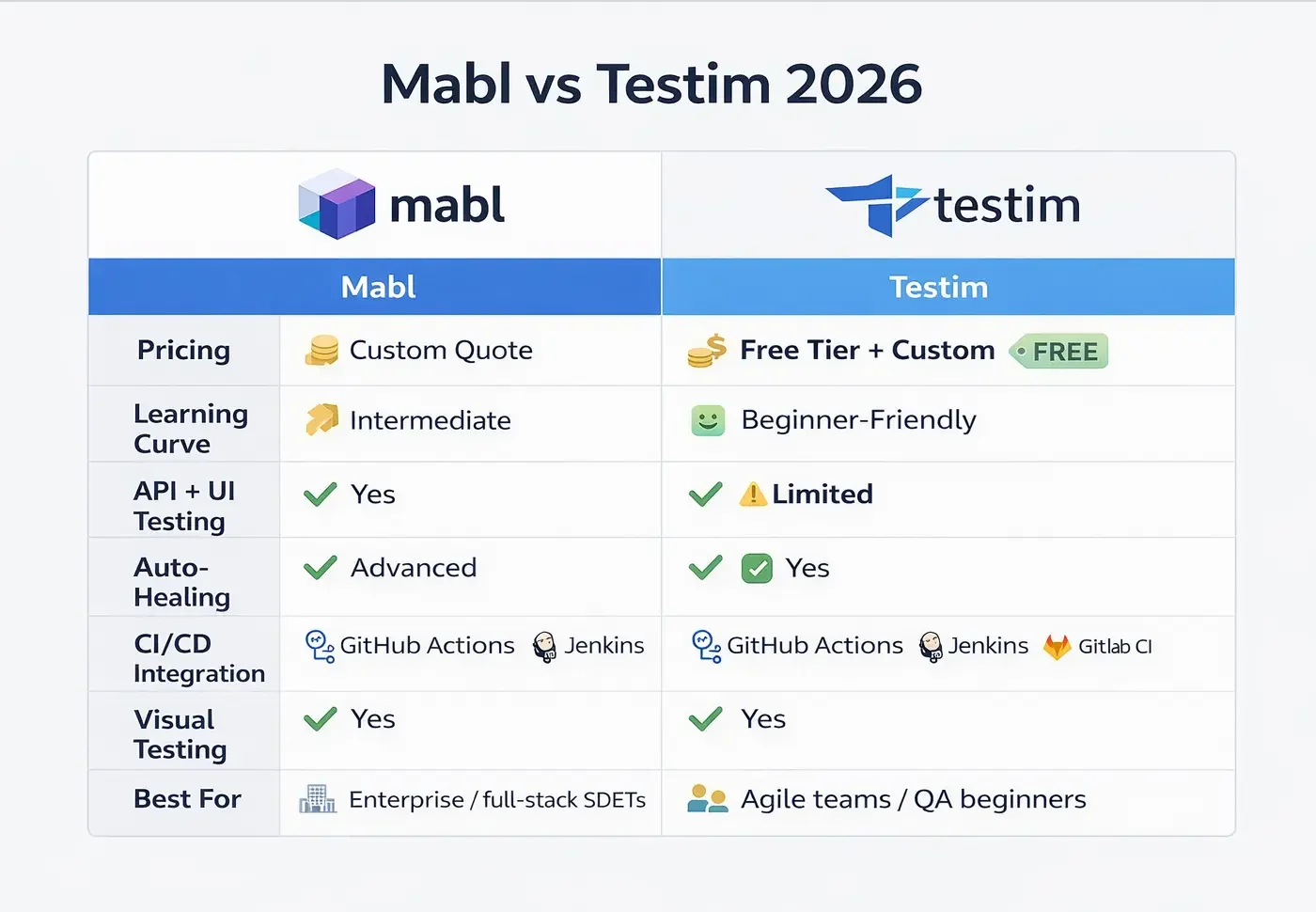
| Feature | Mabl | Testim |
|---|---|---|
| Pricing Model | Custom quote | Free tier + custom |
| Free Trial | On request | 7 days |
| Test Creation | Recorder + Agentic AI | Recorder + Smart Locators |
| Auto-Healing | ✅ Advanced | ✅ Yes |
| API Testing | ✅ Built-in unified | ⚠️ Limited natively |
| CI/CD Integration | GitHub Actions, Jenkins, GitLab CI | GitHub Actions, Jenkins |
| Visual Regression | ✅ Yes | ✅ Yes |
| Shadow DOM Support | ✅ Yes | ✅ Yes |
| Best For | Enterprise / full-stack SDETs | Agile teams / QA beginners |
Here’s a quick visual breakdown of the Mabl vs Testim comparison for easier understanding:
Mabl vs Testim — 7 Proven Differences
Here are the key differences in the Mabl vs Testim comparison that matter for QA engineers and SDETs.
1. Auto-Healing vs Smart Locators — Two Different Philosophies
The core architectural difference in Mabl vs Testim comes down to how each handles dynamic UIs.
Testim’s Smart Locators use a machine learning model trained on DOM snapshots. When a test runs, Testim scores multiple potential element matches and picks the highest-confidence one. This works extremely well for fast-moving front-end codebases where developers rename classes and IDs frequently.
Mabl’s auto-healing works differently. Mabl monitors your application continuously and updates test steps proactively when it detects element changes, rather than resolving them at runtime. This means fewer surprise failures during nightly regression runs.
In real projects, for a QA engineer maintaining 200+ end-to-end tests across a React or Angular app, Mabl’s proactive approach reduces the number of broken tests that make it to CI pipelines. Testim’s runtime resolution is faster to set up but occasionally fails on heavily nested shadow DOM structures.
2. API Testing vs UI-First Focus
This is the biggest capability gap in the Mabl vs Testim comparison — one that many aggregator sites ignore.
Mabl was designed from day one to handle API and UI tests in the same workflow. You can chain an API call to seed test data, run a UI flow, and then validate the API response — all inside a single Mabl journey. For full-stack SDETs building end-to-end coverage across a microservices architecture, this is a significant productivity advantage.
Testim is primarily a UI testing platform. While you can trigger API calls as part of a test using JavaScript steps, native API test management is not a core feature. Teams that need deep API automation alongside Testim typically still reach for Postman or REST Assured for the API layer.
If your role involves building full-stack automation coverage — which is increasingly what SDET job descriptions demand in 2026 — Mabl’s unified approach is a genuine advantage over building two separate toolchains.
3. Scriptless Ceiling — When the AI Fails You
Here’s the real limitation of Mabl vs Testim:
Both tools market themselves as low-code or scriptless. In straightforward CRUD applications and standard e-commerce flows (the kind you practice on Sauce Demo or OrangeHRM), both tools perform well without writing code.
The ceiling appears when you hit:
- Complex data-driven testing with dynamic datasets
- Multi-step OAuth and SSO login flows
- Deep shadow DOM traversal in web components
- Validating encrypted or tokenized API responses
At this point, both platforms require you to drop into custom code. Testim uses JavaScript overrides for complex logic. Mabl supports JavaScript steps and reusable flow parameters. Neither eliminates the need for engineering judgment — they just move where that judgment is applied.
Key takeaway: these tools do not replace your framework skills. They replace the maintenance burden of brittle selector strategies. If you cannot debug a failing test logically, you will still struggle with both platforms.
4. Learning Curve — Mabl vs Testim for Career Growth
For a QA engineer transitioning into an SDET role, the Mabl vs Testim learning curve is meaningfully different.
Testim is faster to start. The free tier, browser extension recorder, and intuitive UI mean you can create and run your first automated test in under 30 minutes. This makes it excellent for QA engineers who are still building automation confidence.
Mabl requires more investment upfront. Setting up a Mabl workspace, configuring application environments, and understanding Mabl’s concept of Branches and Deployments mirrors how enterprise engineering teams manage test environments. This is actually an advantage for your resume — Mabl experience signals senior SDET thinking.
For freelance automation contracts: Testim’s accessibility makes it easier to pitch on smaller budgets. Mabl is more credible in enterprise procurement conversations but requires a demo and a quote, which adds friction to smaller engagements.
5. CI/CD Integration Depth
In the Mabl vs Testim comparison, both tools support integration with GitHub Actions, Jenkins, and GitLab CI. However, the depth and flexibility of these integrations differ significantly in real-world workflows.
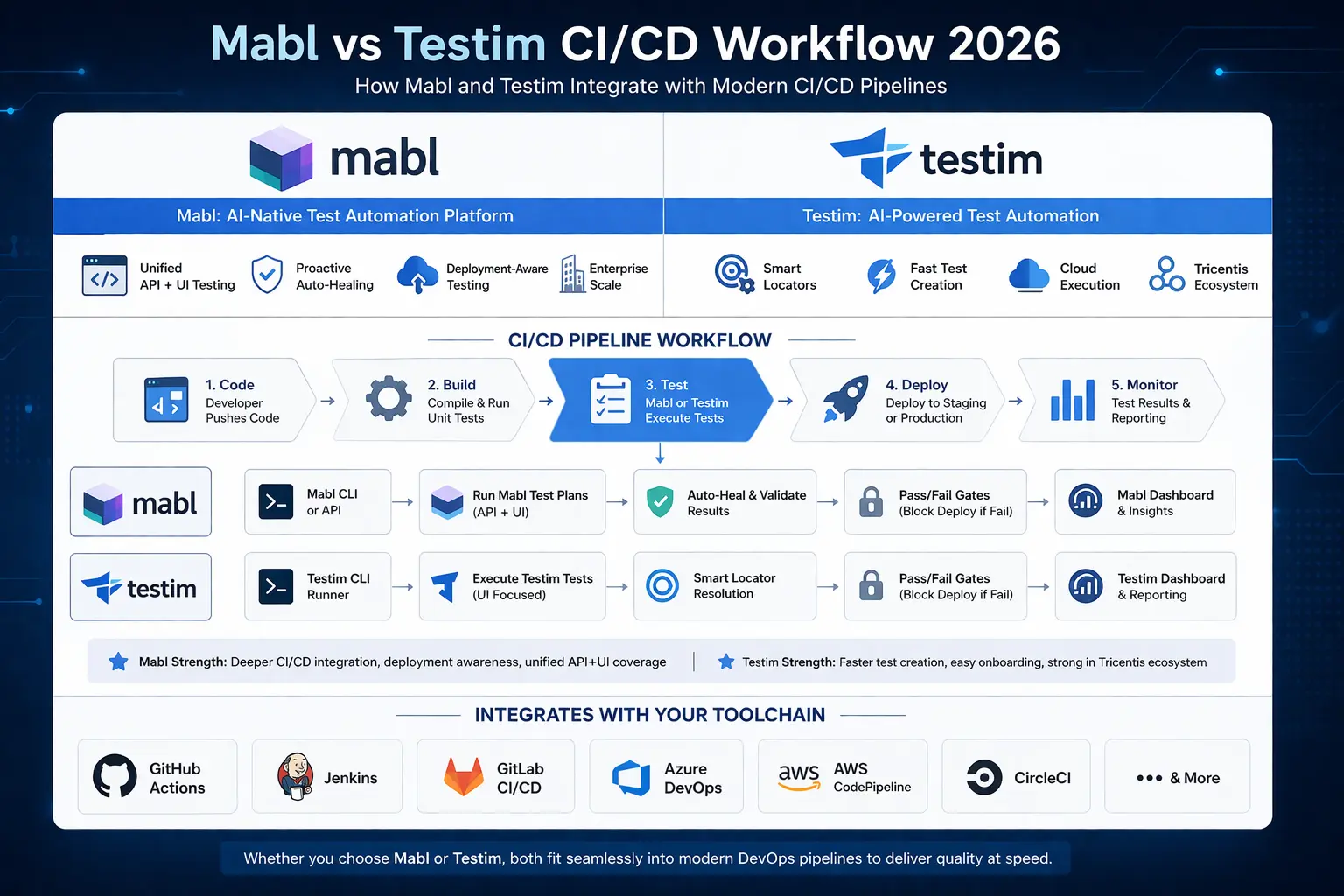
Mabl offers dedicated CLI tooling and native webhooks that report directly back to the Mabl dashboard. You can trigger Mabl test plans from a GitHub Actions workflow and get pass/fail results as deployment gates before a release ships to production. Mabl also integrates directly with deployment tools like Heroku and Netlify, making it genuinely shift-left in practice.
Testim also supports CI/CD triggering via its CLI, but the reporting is less tightly integrated with deployment pipelines. For teams already embedded in the Tricentis ecosystem (using Tosca or NeoLoad), Testim integrates natively — a genuine advantage in large enterprise environments.
For most SDET roles in 2026, either tool will satisfy CI/CD requirements. Mabl has the edge for teams building greenfield pipelines.
6. Visual Regression Testing
In the Mabl vs Testim comparison, both platforms include visual regression testing as part of their standard feature set.
Mabl uses a pixel-by-pixel comparison engine combined with its AI layer to filter out false positives from minor rendering differences like antialiasing or font weight changes. This means your visual tests fail on genuine layout breakages rather than noise.
Testim offers visual validation as an assertion type within its test steps, powered by Visual AI. The implementation is solid for standard viewport comparisons, but it is less configurable than dedicated tools like Applitools Eyes.
If visual regression is a core part of your testing strategy — particularly for a design-heavy application — you should read our Applitools vs Percy comparison for a deeper evaluation of dedicated visual testing tools. For most SDET workflows, both Mabl and Testim provide sufficient visual coverage.
7. Which Tool Is Better for SDETs?
Here is my honest Mabl vs Testim verdict for different scenarios.
Choose Mabl if:
- You are working in or targeting enterprise SDET roles
- Your stack requires unified UI + API coverage in one tool
- You want Mabl experience on your resume for senior positions
- Your team is building a shift-left testing culture with deployment gates
Choose Testim if:
- You are an SQA engineer starting your automation journey
- You need a free tier to practice and build portfolio projects
- You are pitching automation on smaller freelance contracts
- You are already in the Tricentis ecosystem (Tosca, NeoLoad)
Neither tool replaces framework fundamentals. If you want to understand what these AI platforms are actually doing under the hood, you need to have built automation from scratch in Selenium or Playwright first. See our Selenium vs Playwright guide for that foundation.
The Career Reality — Mabl vs Testim for Freelance SDETs
In the Mabl vs Testim comparison, this is the angle most aggregator sites miss: which tool is easier to monetize as an independent automation engineer?
Having reviewed the freelance contract market in 2026, Testim gets more direct mentions in smaller contracts (startups, SaaS teams, agencies) because of its free tier and fast onboarding. Clients without a dedicated QA team will ask for Testim more readily because they can verify it themselves.
Mabl appears in larger enterprise contracts, typically in organizations that already pay for tool standardization. If you position yourself as an automation consultant rather than a tester for hire, Mabl experience carries more weight in those conversations.
The strategic path for an SDET building freelance income: get comfortable with Testim first (use the free trial to build portfolio projects), then pursue Mabl certification and experience for enterprise positioning.
If you are actively building your SDET career path alongside this, this Selenium WebDriver with Python course on Udemy will give you the framework foundation that makes both Mabl and Testim genuinely useful tools rather than black boxes.
Disclosure: This article contains affiliate links. If you purchase through these links, I earn a small commission at no extra cost to you.
Final Thoughts
The Mabl vs Testim debate comes down to where you are in your career and what your team actually needs.
Testim wins on accessibility, speed of adoption, and entry-level affordability. Mabl wins on unified API + UI coverage, enterprise-grade pipeline integration, and proactive auto-healing for large test suites.
For most QA engineers in 2026, Testim is the right starting point. For SDETs building enterprise-grade test architectures or targeting senior automation roles, Mabl’s capabilities justify the investment in learning its platform.
Neither tool eliminates the need for solid automation engineering skills. They amplify them.
Want to see how these compare against dedicated API testing tools? Read our Best API Testing Tools guide.
Frequently Asked Questions
Does Mabl’s auto-healing actually reduce test maintenance compared to Testim’s Smart Locators?
Yes, but in different ways. In the Mabl vs Testim comparison, Mabl heals tests proactively — it detects DOM changes before your next run and updates affected steps automatically. Testim’s Smart Locators resolve element ambiguity at runtime using machine learning confidence scoring. For large regression suites running nightly in CI, Mabl’s proactive approach means fewer broken builds reaching your pipeline. Testim’s approach is faster to set up, but can still fail on deeply nested shadow DOM structures.
Can Mabl handle API testing natively, or do I still need a separate tool like Postman?
Mabl handles API testing natively within the same workflow as your UI tests — no separate tool required. You can chain an API call to seed test data, run a UI journey, and validate the API response all in one Mabl flow. Testim does not have native API test management. Teams using Testim typically still rely on Postman or REST Assured for API coverage, which means maintaining two separate toolchains.
Is Testim free to use in 2026, and what are the actual limitations of the free tier?
In Mabl vs Testim, Testim does have a free tier available as of 2026, which allows limited test executions per month. It is suitable for individual practice, portfolio projects, and small teams evaluating the platform. The free trial for paid plans is 7 days — not 14. For production-scale automation with parallel execution and full CI/CD integration, you will need a paid plan through Tricentis sales. Always check testim.io directly for current tier limits, as they change with enterprise repackaging.
How do Mabl and Testim integrate with GitHub Actions for continuous testing pipelines?
In the Mabl vs Testim comparison, both tools support GitHub Actions integration via their CLIs. Mabl provides native webhooks and deployment-aware test triggering — you can block a production deployment if a Mabl test plan fails. Testim integrates via its CLI runner and reports results back to your pipeline. Mabl has deeper pipeline integration overall, especially for teams using deployment platforms like Heroku or Netlify alongside GitHub Actions. For most SDET roles, either tool satisfies standard CI/CD requirements.
Should I replace Selenium with Mabl or Testim for my automation framework?
No — and this is the most important thing to understand about both tools. Mabl and Testim replace the maintenance burden of brittle selector strategies, not your engineering judgment. If you cannot debug a failing test logically or understand what a DOM traversal is doing, you will still struggle with both platforms. Build your Selenium or Playwright foundation first. These AI tools work best when used by engineers who already understand what they are automating.
Which tool has a steeper learning curve for a QA engineer with no automation experience?
In the Mabl vs Testim comparison, Testim has the shallower learning curve. The browser extension recorder, free tier, and clean UI let you create and run your first automated test in under 30 minutes. Mabl requires more upfront configuration — workspace setup, application environment definitions, and understanding Mabl’s Branches and Deployments concept. That said, Mabl’s complexity mirrors how enterprise engineering teams actually manage test environments, which makes it more valuable on a senior SDET resume.
Does Mabl or Testim support data-driven testing across large datasets?
In Mabl vs Testim, both support data-driven testing, but both also have limits. For straightforward CSV-driven test parameterisation, either tool handles it with low-code configuration. For complex dynamic datasets — especially when validating encrypted API responses or multi-step tokenised login flows — both platforms require custom JavaScript to process the data. Neither tool eliminates the need for scripting at the edges of data-driven scenarios.
Which tool is more suitable for an enterprise QA team running 500+ tests in CI/CD?
Mabl is the stronger choice at enterprise scale. Its unified UI and API coverage, proactive auto-healing engine, deployment-gated pipeline integration, and centralised dashboard reporting are built for teams managing large regression suites. Testim is capable at enterprise scale too — especially within the Tricentis ecosystem alongside Tosca and NeoLoad — but Mabl was purpose-built as a standalone enterprise platform from the start.
Will learning Mabl or Testim help me get hired as an SDET in 2026?
Both tools appear in SDET job descriptions in 2026, but at different seniority levels. Testim tends to appear in mid-level automation engineer roles at SaaS companies and agile startups. Mabl appears more frequently in senior SDET and test architect job postings at enterprise organisations. The most career-effective path is building your Selenium or Playwright foundation first, then adding one AI platform to your resume. Mabl experience signals more seniority; Testim is more common in volume hiring.
Can Mabl or Testim handle shadow DOM elements and modern JavaScript front-end frameworks?
In the Mabl vs Testim comparison, both tools have shadow DOM support as of 2026. Mabl handles shadow DOM traversal through its standard recorder and auto-healing engine. Testim’s Smart Locators also work with shadow DOM, though complex multi-level shadow DOM nesting occasionally requires a JavaScript step override. For applications built on Web Components, Angular, or modern React with dynamic rendering, always validate shadow DOM coverage during your trial period before committing to either platform.