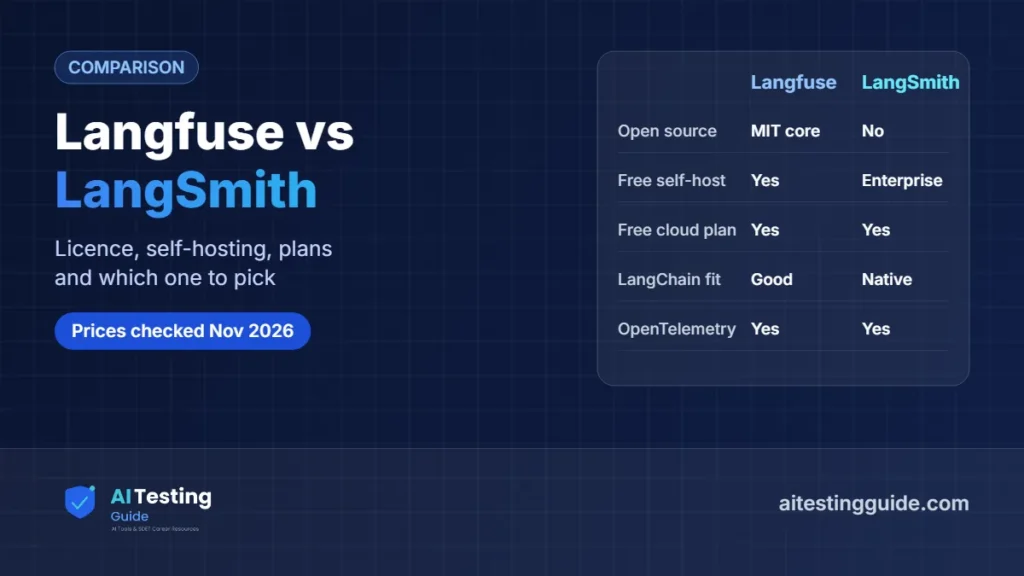
Langfuse vs LangSmith is the most common choice teams face when they need to trace, debug and evaluate an LLM app. Both record every prompt, response and tool call; both run evaluations. They differ most on licence, self-hosting and how they charge. This comparison uses the official pricing pages and docs, read on 13 November 2026.
Pick Langfuse if you want open source (MIT core) and free self-hosting with no usage caps, or a cheap cloud plan (free Hobby, Core from $29/month). Pick LangSmith if your team already builds on LangChain or LangGraph and wants its tightest integration; it has a free Developer plan, Plus at $39 per seat per month, and self-hosting only on Enterprise. Prices checked 13 Nov 2026.
If you are new to the testing side of LLM apps, start with how to test LLM applications. For evaluation frameworks that run in your test suite rather than as a tracing platform, see Promptfoo vs DeepEval.
Table of Contents
Table of Contents
What are Langfuse and LangSmith?
Both are LLM observability and evaluation platforms. You add their SDK (or send OpenTelemetry traces), and every LLM call, retrieval step and tool call in your app is recorded as a trace you can inspect, score and turn into test datasets.
- Langfuse is open source. Its handbook says everything outside the
/eefolders is MIT-licensed, and you can self-host it for free or use Langfuse Cloud. - LangSmith is made by LangChain. Its help centre says it works with any framework, not only LangChain, and it runs as a cloud service, with self-hosted and hybrid options on the Enterprise plan.
Langfuse vs LangSmith at a glance
| Langfuse | LangSmith | |
|---|---|---|
| Made by | Langfuse | LangChain |
| Licence | Open source: MIT core; /ee features need a licence key | Commercial platform (the Python SDK is MIT) |
| Free self-hosting | Yes, no usage caps (Docker Compose or Kubernetes) | No; self-hosted and hybrid only on Enterprise |
| Free cloud plan | Hobby: 50k units/month, 30 days of data, 2 users | Developer: 1 seat, 5k base traces/month |
| First paid plan | Core: $29/month, 100k units, then $8 per 100k | Plus: $39 per seat/month, 10k base traces, then pay as you go |
| Works without LangChain | Yes | Yes (framework-agnostic per its help centre) |
| OpenTelemetry | Supported | Supported (OTLP endpoint) |
| Python SDK (PyPI, 13 Nov 2026) | langfuse 5.2.0, MIT | langsmith 0.14.17, MIT |
How much do Langfuse and LangSmith cost?
Both have a free tier and usage-based paid plans, but they count usage differently: Langfuse bills in “units” and LangSmith in “traces”. A single trace can contain several units, so compare on your own traffic, not on headline numbers.
| Plan | Price (13 Nov 2026) | Included | Notes |
|---|---|---|---|
| Langfuse Hobby | $0 | 50k units/month | 30 days of data, 2 users, no overage |
| Langfuse Core | $29/month | 100k units/month | $8 per extra 100k units; 90 days of data; unlimited users |
| Langfuse Pro | $199/month | 100k units/month | 3 years of data; optional Teams add-on $300/month |
| Langfuse Enterprise (cloud) | $2,499/month | 100k units/month | Yearly commitment unlocks custom volume pricing |
| Langfuse self-hosted (OSS) | $0 | No usage caps | You pay for your own servers; Enterprise licence for SCIM, audit logs, retention policies |
| LangSmith Developer | $0 per seat | 5k base traces/month | 1 seat; pay as you go after that |
| LangSmith Plus | $39 per seat/month | 10k base traces/month | Pay as you go after that |
| LangSmith Enterprise | Custom | Custom | Self-hosted and hybrid options |
For a small team the gap is real. Five people on LangSmith Plus cost $195 a month in seats before usage; on Langfuse Core the same team pays $29 a month plus any usage over 100k units, or nothing beyond hosting costs if they self-host.
Which one can you self-host?
Langfuse, for free. Its handbook says self-hosting has no usage caps, includes all product features in the open-source edition, and can run in air-gapped clusters; you can later switch between open source, Enterprise self-host and Cloud by adding or removing a licence key. Telemetry is on by default and sends aggregated usage data (not traces or prompts); you can turn it off with TELEMETRY_ENABLED=false.
LangSmith offers self-hosted and hybrid deployments only on its Enterprise plan, with custom pricing. If data must stay on your own servers and the budget is small, that usually decides it.
Which works better with LangChain?
LangSmith. It is LangChain’s own product: its help centre says that with LangChain or LangGraph you only need to set one environment variable. Langfuse also integrates with LangChain, and both accept OpenTelemetry traces, so you are not locked in either way. If your app does not use LangChain at all, the integration advantage disappears.
How do they fit into LLM testing?
For QA teams, both tools do two jobs: they show what the model actually did in production (traces), and they let you turn real traces into datasets for evaluation. LangSmith’s docs show OpenTelemetry traces being routed into an experiment and scored by evaluators bound to a dataset. Use them alongside, not instead of, test-suite tools:
- Run fast pass/fail checks in CI with Promptfoo or DeepEval.
- Use Langfuse or LangSmith to watch production, find failing conversations and add them to your test datasets.
- Measure quality with the metrics in our LLM evaluation metrics guide, and watch for hallucinations.
What are the alternatives to Langfuse and LangSmith?
The most common alternatives are Arize Phoenix, Opik, Braintrust, Laminar and Helicone. The table compares them with Langfuse on licence, self-hosting and hosted pricing. We read each vendor’s own pages and repository on 17 November 2026. We did not run these tools ourselves, so there are no speed or quality claims here.
| Tool | Licence | Self-host | Hosted plan and notes |
|---|---|---|---|
| Langfuse (baseline) | MIT for core features | Yes | ClickHouse acquired Langfuse on 16 Jan 2026 and said core stays MIT |
| Arize Phoenix | Elastic License 2.0 (checked 10 Nov 2026) | Yes | Open source tracing and evals on OpenTelemetry; Arize sells a managed product called AX |
| Opik (Comet) | Apache-2.0 | Yes, the full platform, per its README | Tracing, evals, prompt management and monitoring |
| Braintrust | Not open source | Enterprise BYOC only (your own cloud) | Starter $0 (1 GB data, 10k scores, 14 days retention); Pro $249 per month |
| Laminar | Open source; the docs page does not name the licence | Yes, with Docker Compose | Managed Laminar Cloud also available; built for agent tracing |
| Helicone | Not checked for this article | Not checked | Reported in maintenance mode after Mintlify acquired it on 3 Mar 2026 |
Sources for this section: Opik repository, Laminar repository, Laminar docs, Braintrust plans and limits, Arize Phoenix repository, and HackerNoon on the Helicone and Langfuse acquisitions (secondary source).
Pricing and licences change, so check each vendor before you commit.
Which Langfuse alternative should you pick?
- You want a free, self-hosted tool. Compare Langfuse, Opik and Phoenix first. Opik is Apache-2.0 and Langfuse core is MIT. Phoenix uses the Elastic License 2.0, which limits how you can offer it as a hosted service to others.
- You already use OpenTelemetry. Phoenix is built on it, and Laminar describes its tracing as OpenTelemetry-native.
- You mainly build agents. Laminar describes itself as built for AI agents. Opik also lists agent tracing.
- You want a fully managed product. Braintrust is hosted by default, with a free Starter plan. Self-hosting needs the Enterprise BYOC option.
- You are considering Helicone. Helicone says its services stay live in maintenance mode after the Mintlify acquisition, so confirm its roadmap before you build on it.
For the wider picture of testing LLM apps, see our LLM testing guide and the Promptfoo vs DeepEval comparison.
What we did and did not test
This comparison is researched, not a hands-on test. On 13 November 2026 we read the official pricing pages and documentation listed below and installed both Python SDKs from PyPI to confirm their versions and licences (langfuse 5.2.0 and langsmith 0.14.17, both MIT). We did not send traces to either platform, self-host Langfuse, or run evaluations, so there are no speed, usability or accuracy results here. Prices change often; check the vendor pages before you buy.
Sources and Versions Checked
- Langfuse pricing (read 13 Nov 2026)
- Langfuse handbook: Why is Langfuse open source? (licence and self-hosting)
- LangSmith pricing (read 13 Nov 2026)
- LangChain help centre: What is LangSmith?
- LangSmith docs: Evaluate with OpenTelemetry
- PyPI metadata: langfuse 5.2.0 (MIT), langsmith 0.14.17 (MIT), installed 13 Nov 2026
Frequently Asked Questions
What are the best Langfuse alternatives?
The ones most teams compare are Arize Phoenix, Opik, Braintrust, Laminar and Helicone. For a free self-hosted option, start with Opik (Apache-2.0) or Phoenix (Elastic License 2.0). For a managed product, Braintrust has a free Starter plan and a $249 per month Pro plan. Helicone is reported to be in maintenance mode.
Is Langfuse better than LangSmith?
It depends on your setup. Langfuse wins on open source, free self-hosting and low cloud prices; LangSmith wins on LangChain and LangGraph integration and is a fully managed service.
Is Langfuse free?
Yes. The open-source edition is free to self-host with no usage caps, and Langfuse Cloud has a free Hobby plan with 50k units a month (checked 13 Nov 2026).
Is LangSmith free?
There is a free Developer plan with 1 seat and 5k base traces a month; after that it is pay as you go. Plus costs $39 per seat per month (checked 13 Nov 2026).
Can I use LangSmith without LangChain?
Yes. LangChain says LangSmith works with any framework or library, and it accepts OpenTelemetry traces.
Can I self-host LangSmith?
Only on the Enterprise plan, which has custom pricing. Langfuse can be self-hosted for free.
Is Langfuse open source?
Yes. Its core is MIT-licensed; only the modules in its /ee folders need an enterprise licence key.

QA automation engineer. Each guide says what I ran myself and what I only researched, and I update it when things change. About me
One useful email a week
New guides, tool price changes and AI testing news. No spam.